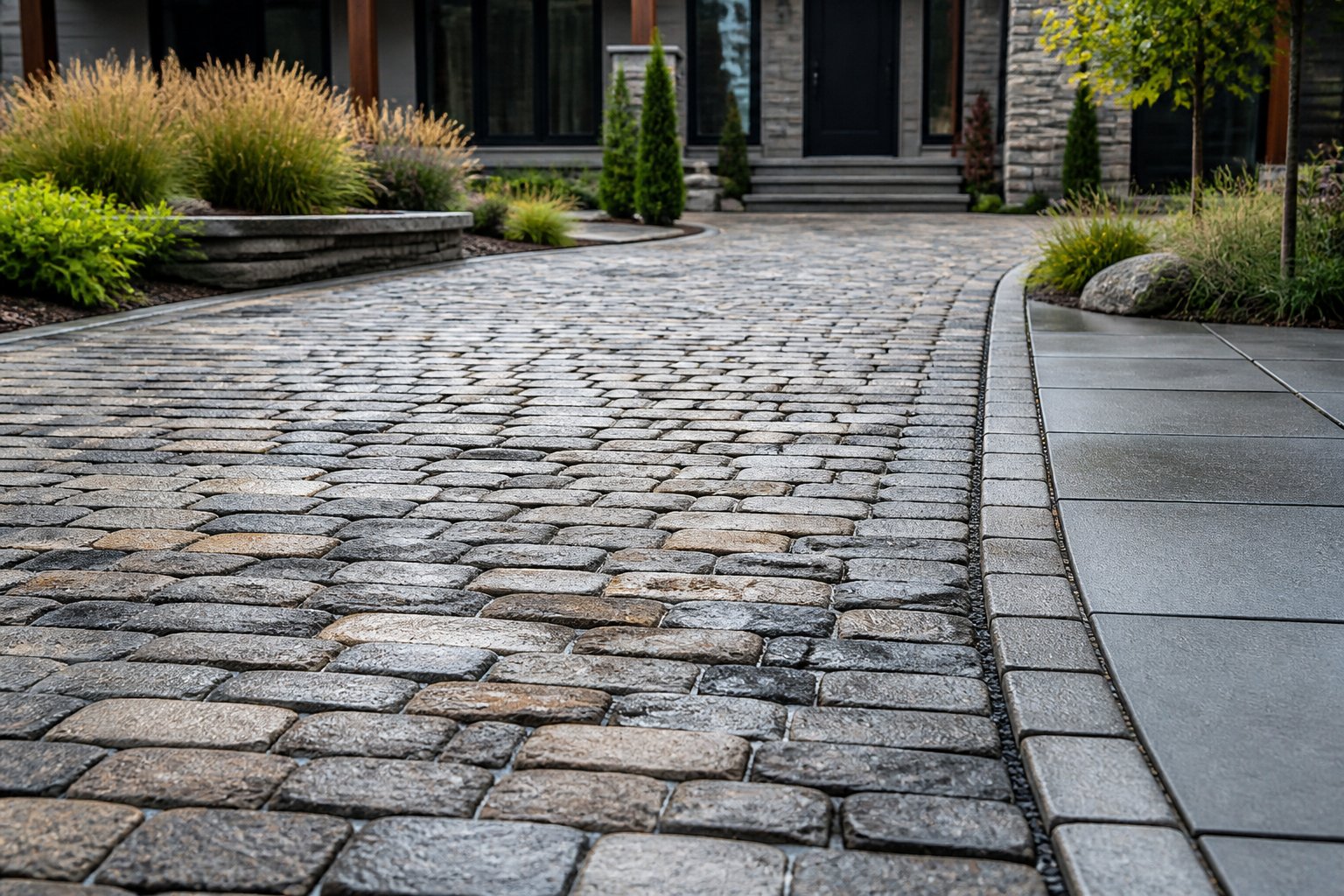
You have a driveway spec sitting on your desk, and the client wants something that looks like it has been there for a hundred years. Poured concrete will not do it. Asphalt definitely will not. A Belgian block driveway is usually the answer that comes up next.
Then the real question follows fast: Is reclaimed stone worth paying more per square foot than new-cut granite? That question deserves a straight answer, not a sales pitch.
Reclaimed European stone carries a worn face and an earthy color range that a fresh saw cut simply cannot fake. It also comes with a real constraint. Supply is limited to what has physically been pulled from old streets and structures, so specifying it late in a schedule creates problems.
Keep reading to learn what makes granite blocks perform under vehicle traffic, what drives installed cost, how cobble driveways compare to asphalt and concrete, and how to build the base and drainage correctly. After you have handled a few pallets of this stone yourself, you stop guessing and start knowing what works.
What Makes a Belgian Block Driveway Perform
Belgian blocks perform because they are dense, roughly cubic pieces of granite that transfer wheel loads down into the base instead of flexing across a slab. Each block carries weight independently, so a single failure never spreads.
Granite is the reason. It is one of the hardest common building stones, with very low water absorption and strong resistance to freeze-thaw damage. Set properly, a cobblestone driveway outlives the house around it.
Granite Density, Dimensional Consistency, and Load-Bearing Strength
Traditional granite Belgian blocks run roughly 4 by 4 by 8 inches, though older reclaimed pieces vary. That thickness matters because depth, not surface area, gives the block its resistance to rocking under a loaded truck tire.
Dimensional consistency controls your joint width. Newly cut granite Belgian blocks are sawn to tight tolerances, so joints stay near a quarter inch. Reclaimed stone varies more, often an eighth to a half inch across a run, which reads as texture rather than error.
For a driveway surface handling daily vehicle traffic, favor blocks with at least one flat bedding face. That single flat side sits into the setting bed and stops the block from spinning under torque.
How Weathered Reclaimed Stone Differs From Newly Cut Granite
Reclaimed blocks were shaped by hand, laid in streets, and worn smooth on the top face by decades of iron wheels and boots. New granite has six sharp-sawn faces and a uniform gray tone that looks manufactured, because it is.
Here is what separates the two in practice:
- Face texture: reclaimed stone is worn concave on top; new stone is flat and abrasive
- Color range: reclaimed pieces show tan, rust, silver, and warm gray in the same palette
- Edge condition: century-old blocks have softened, arise that shed water and hide chips
- Availability: new granite is ordered. Reclaimed stone exists only in what was salvaged
That last point drives every scheduling decision on the project. This is why cost and lead time need to be settled early.
Where Cobble Driveways Work Best on Residential and Commercial Sites
Full-field cobble driveways suit short runs, motor courts, and turnarounds where the texture is seen up close. Long straight approaches often work better with an asphalt or gravel field and Belgian block driveway edging on both sides.
Commercial sites use the same logic. Blocks handle loading zones, aprons, and curbing well because individual pieces can be reset after utility work. For walkways and landscaping borders, a single-course band of stone defines the edge without the cost of a full field. Once you know where the stone goes, the budget conversation gets specific.
Cost Drivers and Long-Term Value
A Belgian block driveway costs more up front than any poured option. Most of that money goes into labor and base, not the stone itself. Set correctly, though, the surface rarely needs replacement.
For edging alone, homeowners typically pay $9 to $11 per linear foot for the blocks, with professional installation on an average driveway running near $1,350, according to a Belgian block driveway edging guide from This Old House. Full-field paving multiplies that quickly.
Material Quantities, Layout Complexity, and Labor
Count roughly 12 regulation blocks per 5 feet of single-course edging. A 60-foot driveway edged on both sides needs about 290 blocks before waste and cuts. Layout complexity is the real multiplier. Straight runs go fast. Curves, radiused aprons, and fan patterns slow a crew down and increase cutting. This adds labor hours to every linear foot.
- Straight edging: fastest install, minimal cutting
- Curved edging: more cuts, tighter joints, higher labor
- Full-field paving: highest material count and the longest setting time
- Aprons and transitions: slowest per square foot due to elevation changes
Why Base Construction Changes the Installed Price
The base under the stone often costs as much as the stone. A driveway base layer typically means 6 to 8 inches of compacted crushed stone, then a setting bed above it.
For edging, contractors frequently use a concrete setting bed. One 80-pound bag of cement blended with about 200 pounds of sand yields roughly 20 feet of base, mixed stiff so it does not squeeze up between blocks.
Skip the solid base and drainage planning. You pay twice. Blocks settle, joints open, and the reset labor costs more than doing it right the first time.
Reclaimed Stone Availability and Early Specification Decisions
Reclaimed material behaves differently from a catalog order. Stone yards stock what has been salvaged. When a lot of century-old European stone is gone, the exact color and wear pattern are gone with it.
New Orleans Brick & Stone stocks reclaimed European stone sold by the square foot, with pricing given directly by phone. Once an invoice is paid, a truck can be on the road within 48 hours. This is a different world from the 6-to 12-month lead times common elsewhere.
Confirm your square footage early, because the comparison against asphalt and concrete only holds up when the stone is actually in hand.
Belgian Block Driveway Compared With Asphalt and Poured Concrete
Asphalt is the cheapest to install and the shortest-lived. Poured concrete lasts longer but cracks in predictable places.
Belgian blocks cost the most up front and outlast both by decades. The difference is structural. A slab is one rigid piece that must absorb every ground movement. A cobble field is thousands of small pieces that move slightly and stay intact.
Historic Character and Visual Texture
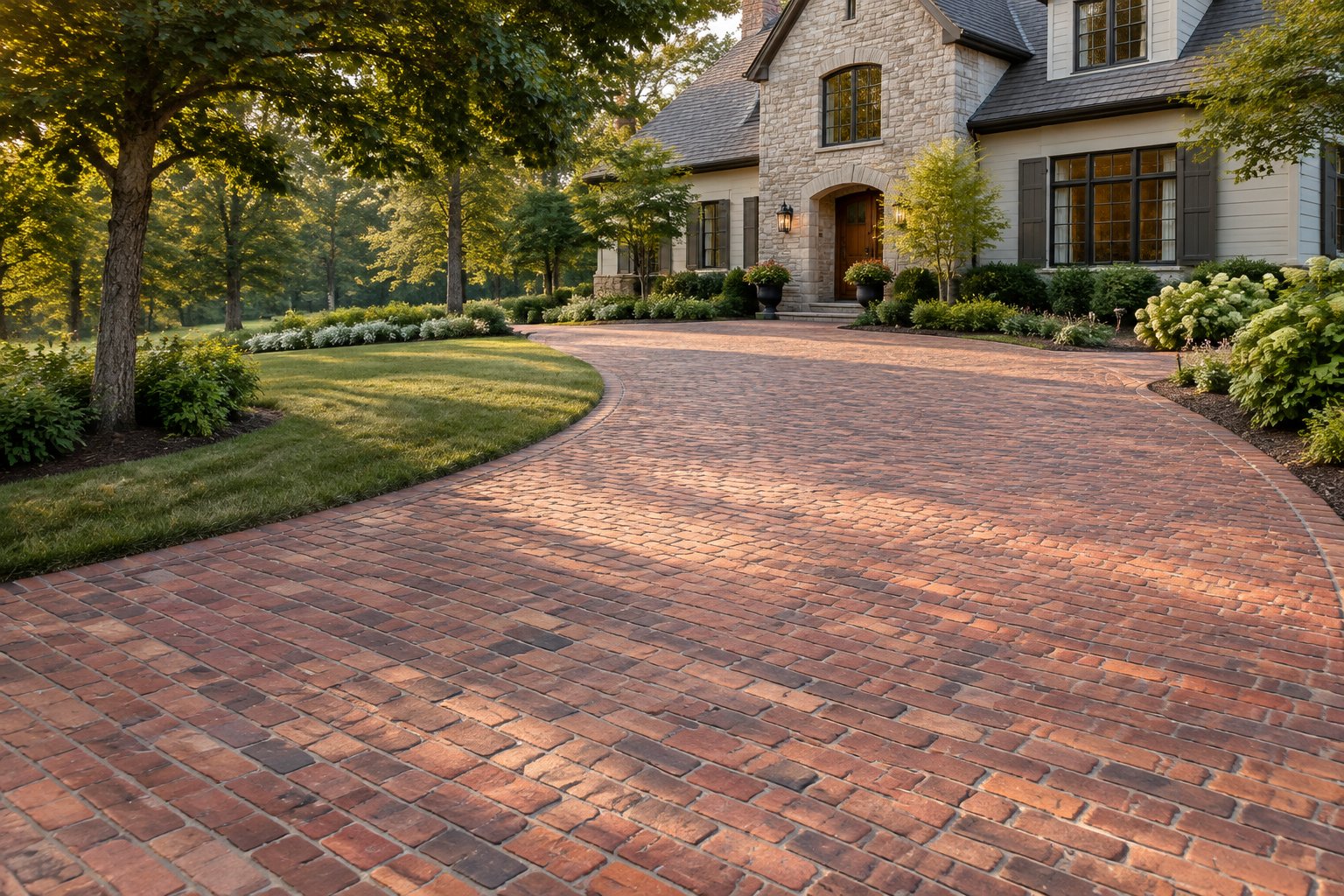
An asphalt driveway reads as infrastructure. Driveway cobblestones read as architecture. That distinction matters when the house is meant to look like it predates the neighborhood.
Reclaimed stone carries earthy hues and a hand-worn patina across every pallet, the same quality that makes reclaimed brick pavers so effective on drives and courtyards. Concrete curbing can be stamped and tinted, but the color sits on the surface and fades unevenly.
Pairing materials works well too. Many Southern homes use stone for the drive and reclaimed brick patios and walkways for the adjoining outdoor spaces, tying the whole site together.
Resistance to Edge Failure, Movement, and Weather
Asphalt fails at the edges first. Without support, the perimeter crumbles under tire loads and frost. Driveway edging in stone gives that perimeter something rigid to bear against.
Concrete moves as a unit, so a single frost heave telegraphs a crack across the entire slab. Individual blocks flex with the ground and settle back. Shifting blocks are a maintenance item, not a failure.
Winter treatment favors stone as well. Deicing salts pit concrete surfaces over time. Granite absorbs almost no water and resists the freeze-thaw cycle that destroys most masonry.
Repairability, Drainage, and Lifecycle Considerations
Repair is where the lifecycle math turns. Lift a few blocks, correct the base, reset them, and the repair disappears. Patched asphalt never matches. Cut concrete never blends.
Drainage is another advantage. Stone-dust joints let some water pass, and blocks can be pitched precisely to move runoff toward gravel beds or drains instead of sheeting toward a garage slab. None of that performance happens without correct excavation and compaction underneath.
Building a Stable Foundation and Drainage Plan
Everything below the stone determines whether the driveway stays flat. Layout first, then excavation, then compaction, then the setting bed. Start with stakes at each end of the run, and a mason's line pulled tight between them. On long or uneven drives, add intermediate stakes so the string never sags.
Layout, Finished Elevation, and Surface Slope
Mark the driveway edges with marking paint, then snap a chalk line on any existing pavement you plan to cut. A straightedge and level confirm your grade before a shovel touches dirt. Set your string line height carefully. For edging, position it less than half the exposed stone height above the pavement.
With a 4-inch exposed face, that means about 2 inches above the surface. Slope the finished surface at least an eighth of an inch per foot away from the house. Work downhill from the high point so drainage stays consistent through the run.
Excavation and Compaction Below the Stone
For edging, dig a trench roughly 12 inches wide and 8 inches deep with a shovel or spade. Move spoil to a wheelbarrow or tarp. You will need topsoil later for backfill.
Full-field cobble driveways need deeper excavation, generally 10 to 14 inches, to hold a proper paver base. Compact the subgrade with a plate compactor, then add crushed stone in 3-inch lifts and compact each one. A hand tamper handles tight spots and edges the plate compactor cannot reach. Skipping lifts is the most common cause of settling in year two.
Selecting a Mortar Bed or Sand-Set Assembly
Mortar-set assemblies use a stiff concrete or mortar bed and lock blocks permanently. Choose this for edging, curbing, and anywhere vehicles cross the perimeter at an angle.
Sand-set assemblies use a 1-inch bedding sand layer over a compacted base. They drain better, cost less, and allow easy resetting. This suits reclaimed natural stone flags and lighter-traffic courtyards. With the bed selected, block placement becomes the detail that decides how the finished surface looks.
Installation Details That Keep Blocks From Moving
Blocks stay put when they are set tight, tapped to a line, and locked at the perimeter. Everything else is finished work. Shovel a few inches of stiff mix into a 3-foot stretch, smooth it with a trowel, and set your first block hard against the pavement edge.
Setting Lines, Spacing, and Block Orientation
Lay out 10 blocks ahead of yourself so you can choose faces as you go. Seat each block with a rubber mallet until the top meets the mason's line.
Orient the best-weathered face up and outward. On reclaimed stone, that worn top face is the whole reason you specified the material. Butt blocks tight for edging. For a full field, hold a consistent quarter- to half-inch joint so stone dust can lock the assembly.
Cutting Curves, Aprons, and Transitions to Walkways
Cut with a diamond-bladed saw or grinder, and wear eye protection every time. A brick set and hammer handle rough splits when a saw cut would look too clean. At the end of a row, avoid one small sliver. Trim the last four stones by the same amount so the size change reads as intentional. A rented concrete saw makes clean cuts along existing asphalt edges.
Transitions to walkways need a shared elevation and a soldier course to hold the line: the same principle used in herringbone reclaimed brick patio layouts.
Joint Finishing, Backfill, and Landscape Cleanup
Sweep stone dust or ground limestone into the joints. Skip sand, which attracts ants and washes out faster. Do not chase it with a garden hose. Let rain settle the dust naturally. Then apply a second pass after the first rainfall to lock the joints.
Backfill behind the blocks with topsoil, then seed or mulch. That finished edge is what makes the material choice visible from the street.
Specify Authentic Stone Before the Project Schedule Tightens
Reclaimed stone is not manufactured on demand. Confirming what exists before you draw the Belgian block edging detail saves rework later. Ask three questions early: how many square feet are on hand, what the color range looks like, and how fast a truck can leave.
Confirming Reclaimed European Stone Inventory by Phone
A phone call answers in five minutes what an email chain takes a week to sort out. Someone can walk the yard, count pallets, and tell you what is actually there. Inventory is limited to what has been physically reclaimed from historic structures, so quantities move. Larger jobs should confirm before the concrete base and drainage work begin.
Planning for Square-Foot Pricing and Freight Delivery
Reclaimed European stone is sold by the square foot, with current pricing given by phone. Blocks ship on pallets by freight carrier, curbside unless you arrange otherwise. Order preparation typically takes 2 to 3 business days. Once an invoice is paid, a truck can roll within 48 hours. Have a forklift or crew ready, since granite pallets are heavy.
Maintaining a Finished Driveway Over Time
Sweep debris and rinse the driveway surface occasionally. Reset any loose block in fresh mix rather than waiting for neighbors to shift. Refresh stone dust in the joints every few seasons and pull weeds as they appear. That is the entire maintenance program for a properly built stone drive. The curb appeal only improves as the patina deepens.
Getting the Stone on Site Before Your Crew Needs It
A Belgian block driveway costs more up front, and it earns that back through decades of service, easy repairs, and a look no poured surface can copy. The premium buys weathered faces and hand-worn edges that only century-old stone carries.
If you are specifying now, the timing question matters more than the price question. Reclaimed stock is finite. The color range you approve today is the one that ships.
Call New Orleans Brick & Stone at 225-284-7529 and ask what reclaimed European stone is on the yard this week, what it costs per square foot, and how quickly a truck can reach your site. You will get a real answer from someone who has handled the material, not a quote that takes three weeks.
Frequently Asked Questions
What Is a Belgian Block Driveway?
A Belgian block driveway is a drive surfaced or bordered with dense granite blocks, typically around 4 by 4 by 8 inches. The blocks are set individually over a compacted base, either mortared or sand-set, so they carry vehicle traffic without cracking like a slab.
How Much Does a Belgian Block Driveway Cost?
Edging alone commonly runs $9 to $11 per linear foot in materials, with professional installation near $1,350 on an average driveway. Full-field cobble driveways cost considerably more because of block quantity, base depth, and setting labor.
What Is the Difference Between Belgian Block and Cobblestone?
Belgian blocks are cut to a fairly regular rectangular shape, while true cobblestone is rounded, river-worn stone. Both read as historic, but Belgian blocks sit flatter and are easier to lay in straight courses.
Should Belgian Blocks Be Installed Tight Together on a Driveway?
For edging and curbing, set blocks tight against each other so the perimeter acts as one continuous restraint. For a full field, hold a consistent quarter- to half-inch joint so stone dust can lock the surface.
How Much Does Belgian Block Edging Cost per Linear Foot?
Expect roughly $9 to $11 per linear foot for the blocks themselves, plus concrete, stone dust, and topsoil. Labor adds to that, with straight runs costing less per foot than curves.
What Are the Pros and Cons of Using Belgian Blocks for Driveway Edging?
Pros include lasting durability, easy repair, strong edge support for asphalt, and authentic historic character from reclaimed stone. Cons are the higher up-front cost, the labor of trenching and setting, and limited reclaimed inventory that requires early ordering.