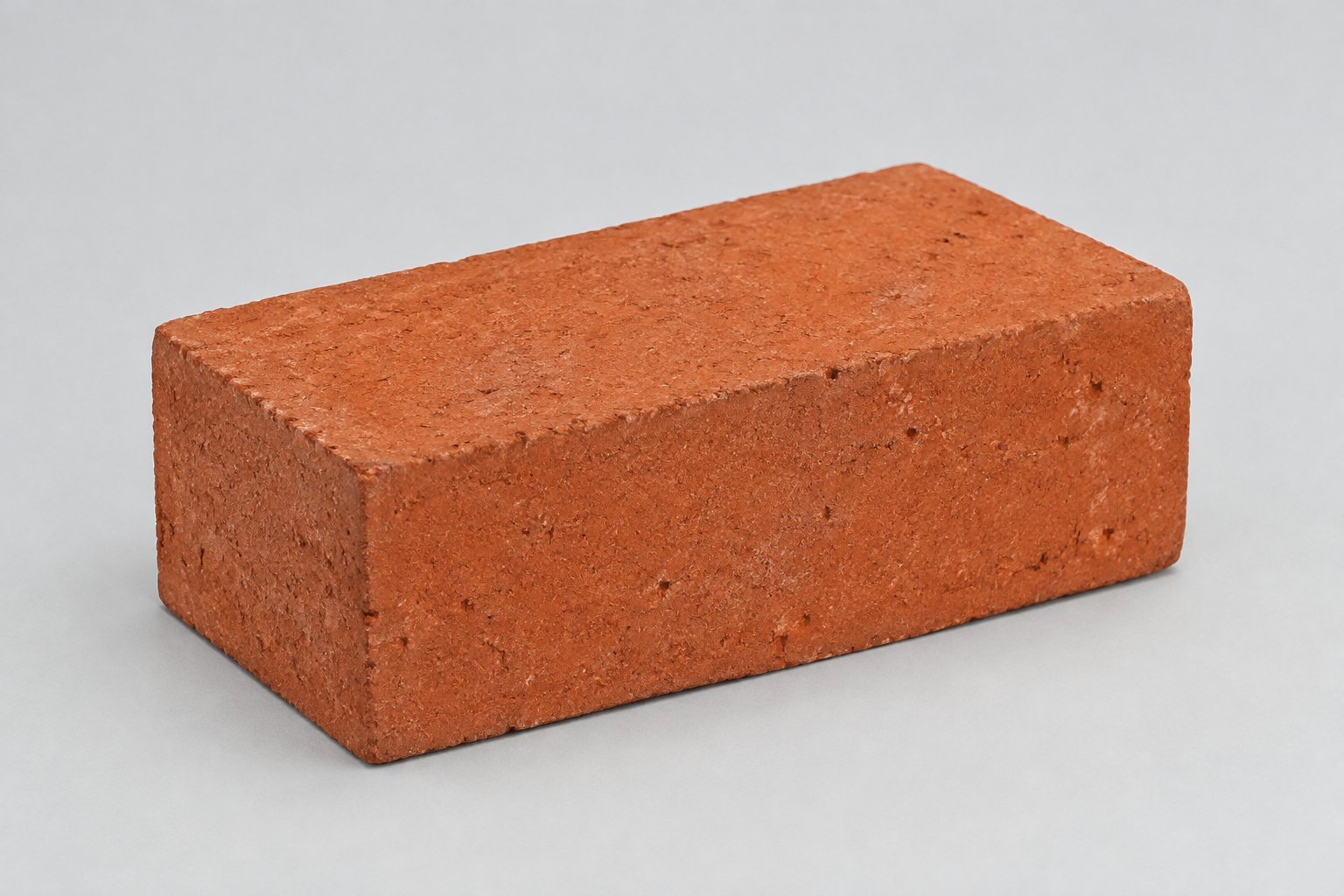
A queen size brick measures 2 3/4 inches deep, 2 3/4 inches tall and 7 5/8 inches long, and lays about 5.76 bricks per square foot of wall with a standard 3/8 inch mortar joint. Some plants ship a 3 inch deep version, so check the spec sheet before you count pallets.
That taller face is the reason builders reach for it. Fewer units, fewer joints to tool, less mortar.
The catch arrives when the new wall has to sit next to an old one, because a brick size name describes a modern factory product and walls built before standard sizes existed do not follow it.
Reading the dimensions correctly
US brick dimensions are written as thickness, or bed depth, then height, then length. On a queen the first two figures are usually identical, which makes it easy to mix up the orientation.
The bed depth runs into the wall. The height is the vertical face you see in each course. The length is the long face along the wall when the brick is laid as a stretcher. Queen comes out at roughly 70 by 70 millimeters across the end and 194 millimeters long. If a quote shows only 2 3/4 by 7 5/8, ask which dimension is missing before you order anything.
There is no single factory standard for queen. One manufacturer's sheet gives 2 3/4 deep by 2 3/4 high by 7 5/8 long, while another lists the same brick at 3 inches deep. A quarter inch of bed depth changes your air space and your lintel leg, so confirm it with your supplier before framing goes up.
Three numbers describe one brick and they are not interchangeable. The specified size is what the maker is aiming for. The actual size is what comes out of the kiln within tolerance. The nominal size is specified plus one mortar joint, so a 7 5/8 inch queen with a 3/8 inch joint is nominally 8 inches long. When you write a specification, list the specified dimensions and the joint width, and our specification support works from exactly those measured figures.
Queen against the other sizes
Queen sits between modular and king: a taller face than modular, a shorter length than king, and shallower than both modular and standard. Face size sets your unit count and depth sets how the brick fits the cavity.
All figures assume a 3/8 inch joint and running bond. King is the size that drifts most between makers: some run 2 3/4 inches tall, which drops the count nearer 4.6 per square foot.
A bigger face means fewer face brick, and the saving compounds through mortar and labor as well as material, which is where most of the 15 percent or so that people quote on wall cost actually comes from. The shallower bed also cuts weight by 20 to 25 percent against modular, which can mean a lighter lintel.
The trade-off is fit. A 2 3/4 inch bed in a pocket framed for 3 5/8 inch modular leaves a gap, and your residential air space still needs to be a full inch. If you are weighing new queen against old brick for character, the reclaimed brick vs new brick decision turns on depth and face as much as it does on color.
Working out quantities
Add the joint to the face length and height, multiply, then divide 144 by the result. For queen that is 7.625 plus 0.375 giving 8, times 2.75 plus 0.375 giving 3.125, which makes 25 square inches, and 144 divided by 25 is 5.76. The same method works for any size, and it assumes running bond where only the long face shows.
Published counts vary slightly, with some sources rounding queen to 6 per square foot and others giving 5.8. Any of those is fine for estimating; none of them is fine for ordering without a waste allowance.
Coursing is where estimates usually go wrong. A 3/8 inch joint gives a queen course of 3.125 inches, which is 3.84 courses per foot and never lands on a clean foot. To line up with modular openings and block backup, masons generally lay queen at five courses per 16 inches, a 3.2 inch course, which needs a joint nearer 0.45 inch. Tell your mason which coursing you expect, because it changes both the joint width and the brick count.
Then take net wall area after openings, multiply by 5.76, and add waste. Five to ten percent covers cuts and breakage on new brick in running bond. Reclaimed brick wants more, because sizes shift within a single pallet, and if you are choosing reclaimed bricks you should order the whole quantity at once, since a later batch out of a different building will not match.
For cost, multiply bricks per square foot by unit price. A queen wall at a dollar a brick is about $5.76 a square foot in brick alone, with mortar, sand and ties on top.
Specifying it for the job
Queen is sold almost entirely as facing brick for residential veneer. It is not the usual choice for load-bearing work, where deeper units and solid or hollow sections are standard, and a queen facing brick should never go underfoot, because paving brick is a separate product class with different requirements.
Thin brick is cut or made at around half an inch deep and is commonly offered in a queen face size, which gets you the look on a wall that cannot take full depth. Reclaimed thin brick does the same thing with genuine antique faces rather than manufactured ones.
Two layout details need settling on the drawings rather than on site. Queen does not turn a corner cleanly in half running bond, because the bed depth is shorter than half the length, and the usual fix is to clip alternate corner units about three quarters of an inch short, though some masons adjust the joints instead. Soldier courses over openings also course out differently, and a 4 1/2 inch cut paired with a rowlock is a common answer.
On standards, ASTM C216 covers facing brick, C62 covers building brick and C652 covers hollow brick, and between them they set weathering grade, appearance type and size tolerances. What they do not do is define queen, king or modular, because a size name is a trade convention rather than a standard. Your specification still needs written dimensions. That matters even more with older material, where period-correct project specs rest on measured units and documented sourcing, since antique brick was never made to these standards in the first place.
Why queen will not match a historic wall
Pre-1900 brick is smaller, softer and more irregular than anything modern, and it was laid in lime mortar. Every brickyard used its own molds and clay shrank differently batch to batch, so a wall from 1880 can hold bricks varying by a quarter inch in length. Queen's tall 2 3/4 inch face and shallow bed match none of that, and laid next to genuine antique brick the course lines will not meet even when the color is close.
A match comes down to four things: size, color range, texture and mortar. Size leads, because the eye reads course height before it reads shade. Mortar matters nearly as much, since it covers something like a fifth of a wall's surface, and a hard gray cement joint will spoil good brick. On soft old brick, hard Portland-rich mortar also traps moisture and forces it out through the face, which spalls it, so ask your mason for a lime mortar matched to the original.
Measure at least five bricks rather than one. Record length, height and depth to the nearest sixteenth, the joint width, and the height of five courses together, which is the most reliable way to capture an irregular wall.
Then send a daylight photograph with a coin or a tape in the frame, or better, post us a loose brick with the frog visible. Our brick matching starts from real numbers rather than a color impression, and standard samples are free to the trade and ship in about two business days.
Choose by measurement, not by name
Queen is a sound, economical size for new residential veneer. Roughly 2 3/4 by 2 3/4 by 7 5/8 in most lines, about 5.76 bricks per square foot, coursing five to sixteen inches. Confirm the bed depth with your supplier because some plants make it three inches, and settle the clipped corners and soldier details with your mason before anybody builds.
For work beside an old wall, put the size name aside entirely and measure. Antique brick follows the mold of whichever yard made it, and the right replacement matches length, height, depth, color range, texture and mortar together rather than any one of them.
Call the New Orleans office on 225-284-7529 or email hays@bourgeoismaterials.com and we will tell you honestly whether a match exists for your wall before you commit to a size.
Frequently asked questions
What size is a queen brick in inches?
Most are 2 3/4 inches deep, 2 3/4 tall and 7 5/8 long. Some manufacturers make the bed 3 inches deep, so check the product sheet rather than assuming.
Queen or modular?
Queen is half an inch taller and about seven eighths of an inch shallower than a 3 5/8 inch modular, at the same 7 5/8 length. The taller face means about 5.76 per square foot against roughly 6.86 for modular.
How many cover a square foot?
About 5.76 with a 3/8 inch joint in running bond. Add five to ten percent for waste on new brick, and more for reclaimed or for a layout with a lot of cuts.
King or queen?
King is about two inches longer at roughly 9 5/8, with a similar depth, which drops the count to somewhere between 4.6 and 4.8 per square foot depending on the king height.
Does queen cost less per square foot?
Usually, because you lay fewer units and use less mortar and labor. Compare quotes per square foot of finished wall rather than per thousand bricks, since a more expensive queen can still produce a cheaper wall.
Can queen match an old wall?
Rarely. Pre-1900 brick predates modern size standards and varies from yard to yard. For a seamless repair or addition, match measured reclaimed brick on size, color range, texture and mortar.