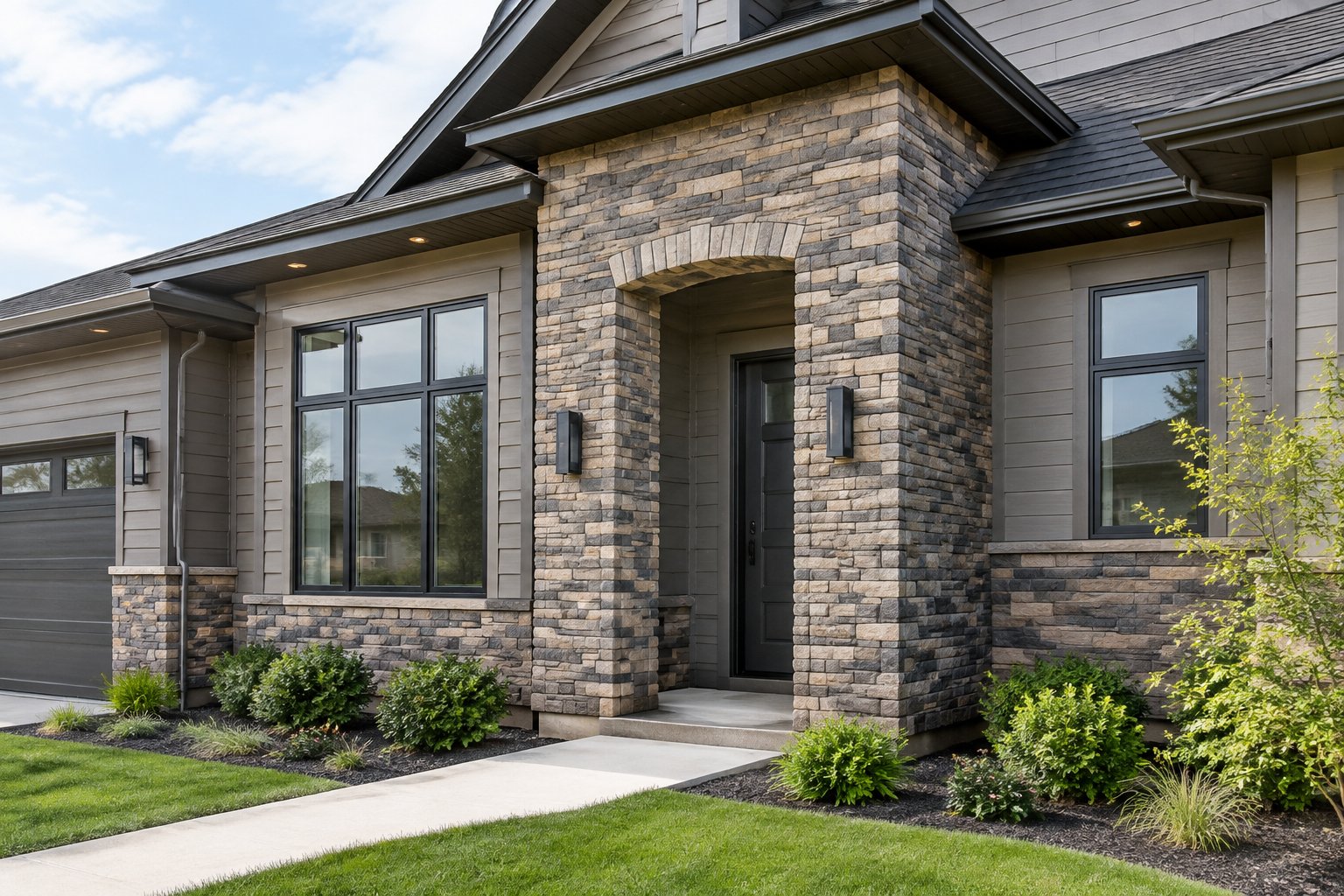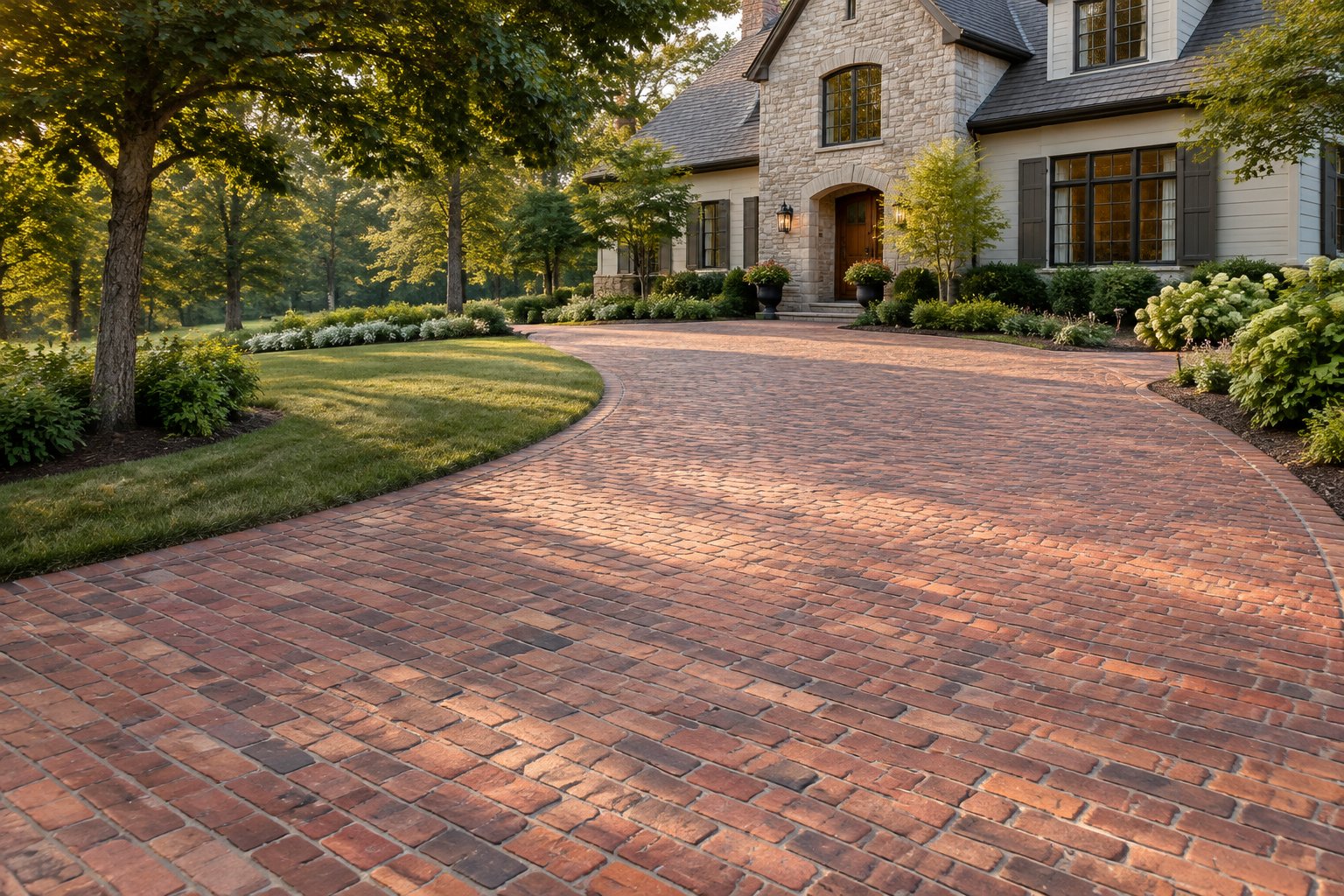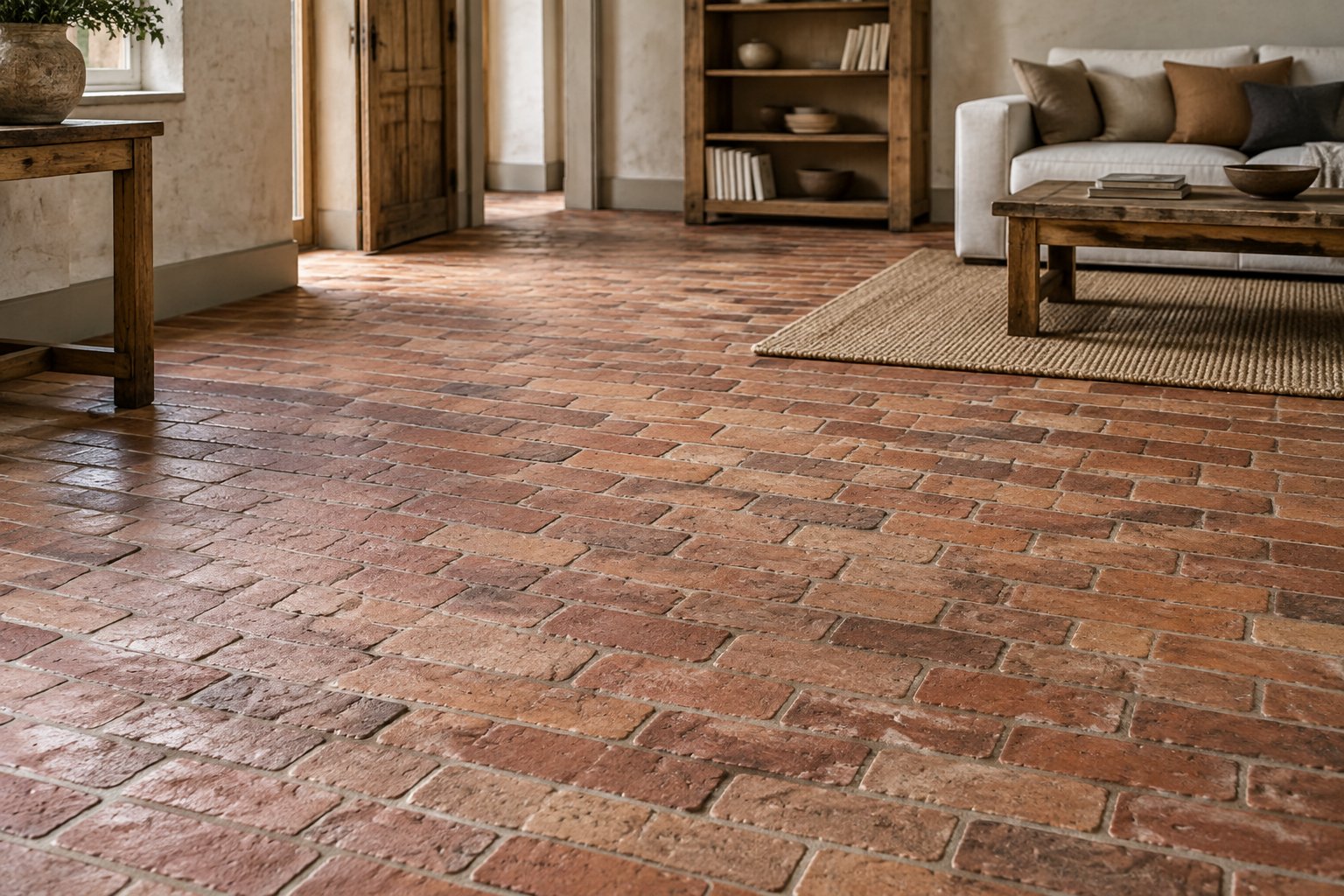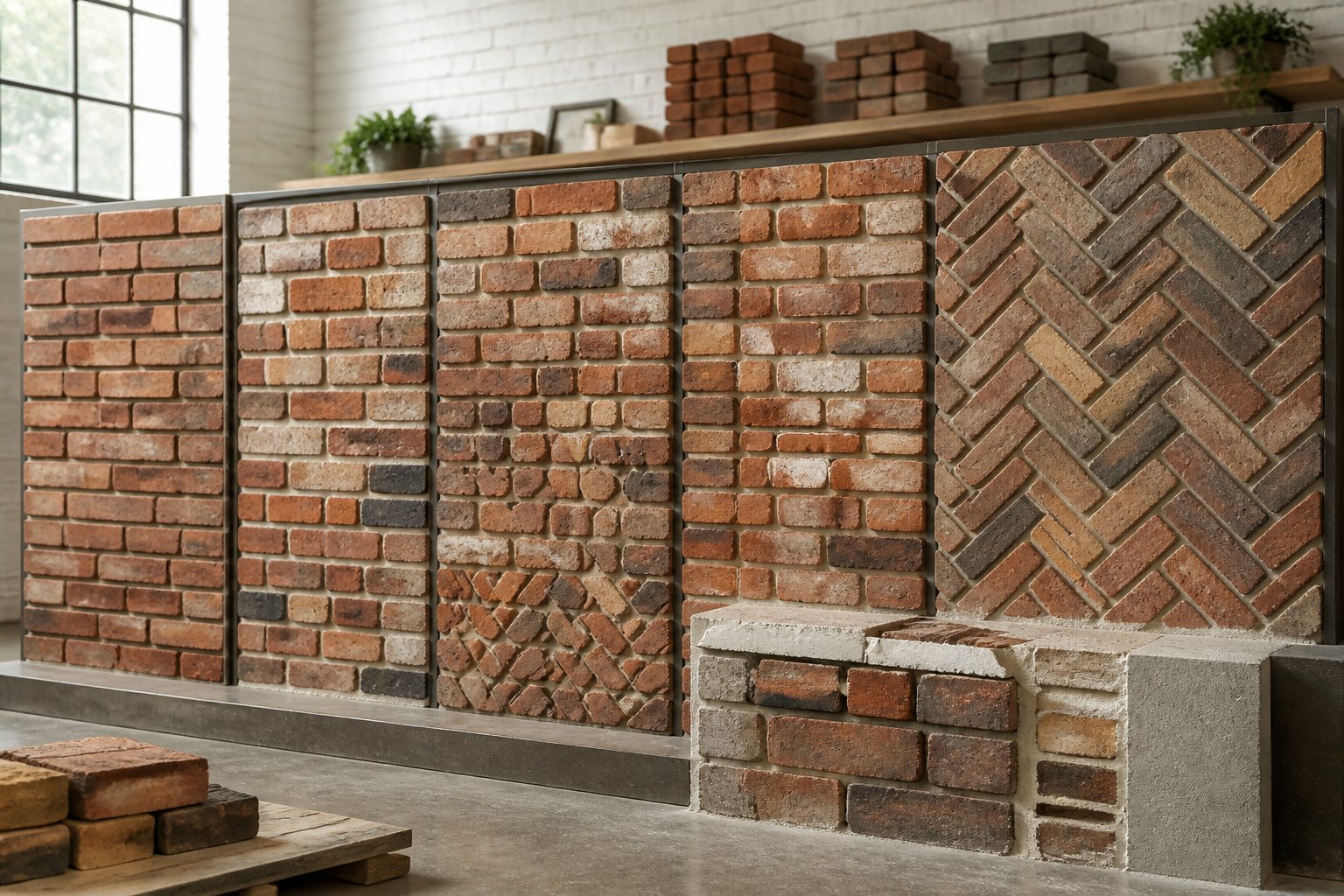
You have a wall elevation to finalize this week, and the bond pattern is the last note left blank on the drawing. That single choice changes your brick count, your cut waste, your mason's hours, and how the finished wall reads from the street.
With new brick, you can pick any of the standard brick wall patterns and trust the math. With reclaimed brick pulled from 100-year-old buildings, the math shifts, because the units themselves are not identical.
That is the part most pattern guides skip. Reclaimed Soft Reds, Hard Tans, Old Chicagos, and St. Louis Reds each carry their own sizing spread, edge wear, and depth of patina.
A stack bond that looks crisp in a rendering can look restless in soft red brick with a quarter-inch size range. A Flemish bond that seems fussy on paper can be the thing that makes a new facade read as if it has stood there since 1890.
Keep reading to learn how each common bond performs with authentic reclaimed brick, which layouts suit facades, fireplaces, floors, and garden walls, and how mortar joints and layout control affect the finished look. You will also get sizing context for specific reclaimed varieties and practical steps for sample panels. Pick the bond first, then confirm the brick can carry it.
Choosing Brick Wall Patterns for Reclaimed Material
Start with the bond, not the brick. The pattern sets the module, and the module tells you what tolerance your material can carry without the courses drifting.
Read the Bond Before Selecting the Brick
Every bond assumes a relationship between brick length and brick width. A running bond only needs consistent length. Flemish and English bonds need length and width to work together, because headers and stretchers share the same course. If your reclaimed brick varies more in width than in length, the header-heavy bonds will fight you.
Reclaimed brick from pre-industrial buildings runs looser than modern brick. Handmade units commonly land near 8 inches long, 3 3/4 inches wide, and 2 1/4 inches tall, with a spread of an eighth to a quarter inch in any direction.
Machine-made reclaimed brick sits tighter, often within a sixteenth. Knowing which family you are buying tells you which patterns are realistic before you commit ink to the drawing.
Match Pattern Scale to Wall Size and Viewing Distance
Pattern scale reads differently at 3 feet than at 30. A fireplace surround seen from a sofa shows every joint, so a busy bond can crowd a small wall. A two-story facade seen from the curb needs some rhythm. Otherwise, it flattens out.
- Small planes under 40 square feet: running bond or herringbone, kept tight and simple
- Feature walls seen up close: stack bond or basketweave, if the brick sizing is uniform enough
- Full elevations and chimneys: Flemish, English, or American bond for visible course rhythm
- Garden walls and low site walls: running bond with a header course cap for a period look
Separate Structural Masonry From Veneer and Thin Brick
Most brick today is a skin, not a structure. As This Old House mason Mark McCullough puts it in a guide to brick patterns: "everything is a veneer," which frees you to choose a pattern without carrying load through the brickwork.
That matters for reclaimed work. On veneer, header courses are usually half bricks laid to look like headers. Thin brick, typically 1/2 to 3/4 inch thick, gives you the same face and patina at a fraction of the shipping weight. Load-bearing walls are a different job entirely. Structural integrity there belongs to an engineer, not a pattern chart.
With those ground rules set, the five bonds you will actually specify become easier to compare.
The Five Bonds Most Often Specified
These five cover the vast majority of reclaimed brick specs, from facades to hearths to pathways.
Running Bond and Stretcher Bond for Facades and Fireplace Surrounds
Running bond, also called stretcher bond, offsets each course by half a brick. It is the most forgiving pattern for reclaimed material, because only length consistency matters, and small width variation disappears into the wall. Cut waste stays low. Cuts happen at the ends of runs, not throughout.
For fireplace surrounds, running bond in Soft Red reclaimed brick lets the color variation carry the interest. The pattern stays quiet so the patina does the work.
Stack Bond for Controlled Contemporary Feature Walls
Stack bond aligns every joint vertically. It looks clean and modern. It is the least forgiving pattern you can pick for reclaimed brick. Any length variation shows immediately as a wandering vertical line.
If you want stack bond with reclaimed character, specify machine-made units or thin brick, and sort by length before laying. Expect your mason to spend real time culling.
Flemish Bond for Decorative Historic Rhythm
Flemish bond alternates a stretcher and a header in every course. It produces a tight, almost diamond-like rhythm that reads as authentically old at any distance. It is common on Colonial and Federal facades across the South. Flemish uses more brick than running bond because of the headers, and it demands careful joint control. On veneer, half bricks stand in for full headers.
English Bond for Traditional Load-Bearing Appearance
English bond alternates full courses of stretchers with full courses of headers. It reads heavier and more formal than Flemish. It suggests a thick, load-bearing wall even on a veneer. Because every other course is headers, brick counts climb. Budget for that when you compare it against reclaimed brick cost factors on a large elevation.
Herringbone for Floors, Hearths, and Brick Pathways
Herringbone sets brick at 45 or 90 degrees in a zig-zag. It is the strongest interlocking layout for a brick pathway, patio, or hearth, because loads transfer across multiple units. It also generates the most edge cuts and the most waste, often 10 to 15 percent.
A herringbone reclaimed brick patio rewards the extra labor with a floor that looks centuries old the day it is finished. Beyond these five, a handful of older layouts still earn their place on traditional elevations and garden features.
Other Historic Layouts for Walls and Garden Features
American bond, cross bond, and basketweave show up constantly in restoration work and landscape details, and each solves a specific problem.
American and Common Bond for Broad Traditional Elevations
American bond, also called a common bond, runs three to seven courses of stretchers between a single header course. It came out of early colonial practice as a way to conserve brick while still tying courses together. On a broad elevation, it gives you a visible horizontal rhythm without the brick count of English bond.
This is the workhorse for large residential facades in reclaimed brick. The stretcher runs absorb sizing variation, and the header course every sixth or seventh row gives the eye a line to follow.
Cross Bond and Header-Led Details
Cross bond offsets alternating stretcher courses so the vertical joints form a stepped, cross-like figure. It is a good alternative when your brick is not a true 2-to-1 ratio, since it does not depend on width matching half the length.
Header-led details, such as soldier courses over openings and header bands at water tables, give you period accuracy at low cost. A single header band on an otherwise plain running bond wall can shift a new build from generic to convincing.
Basketweave Pattern for Patios and Garden Walls
Basketweave pairs two bricks in one direction, then two in the other. It needs bricks that measure a true 4 by 8, or you get gaps. Standard reclaimed brick often falls short of that ratio, sometimes by three-quarters of an inch across two widths.
- Basketweave works when: your brick is close to a true 4 by 8, and the surface is a flat patio or terrace
- Basketweave struggles when: sizing varies, or the area needs load-bearing interlock like a driveway
- Better alternative: running bond or herringbone with reclaimed brick pavers for tighter tolerance
Pattern choice is only half the equation, because reclaimed brick itself changes how any layout reads once it is up.
How Reclaimed Brick Changes the Finished Pattern
Reclaimed brick shifts the visual weight from the pattern to the material. The bond becomes a frame, and the brick texture fills it.
Sizing Tolerances in Soft Red, Hard Tan, Old Chicago, and St. Louis Reds
Each reclaimed variety carries its own spread. Soft Reds, pulled from pre-1900 Southern buildings, are handmade and run the loosest, with soft edges and heavy face wear.
Hard Tans are denser and more uniform, salvaged from later industrial structures. Old Chicago brick shows tumbled edges and heavy mortar staining. St. Louis Reds tend to be machine-pressed with crisp creases and deep red faces.
Practical read: Soft Reds and Old Chicagos want a running bond or herringbone. Hard Tans and St. Louis Reds can carry stack bond or Flemish without drifting.
Using Patina, Worn Edges, and Color Variation Without Losing Order
Blend from at least three pallets as you lay. Pulling from one pallet at a time creates color banding across the wall. Your bricklayer should be dry-stacking a few square feet ahead to sort out any brick that reads too dark or too pale.
Worn edges widen the visual joint even when the mortar joint is consistent. Expect a reclaimed running bond wall to read with joints looking closer to 1/2 inch when they are struck at 3/8. That softness is the point. It is one reason reclaimed brick beats new brick on character.
Planning Corners, Openings, and Sample Panels
Corners are where patterns fail. Flemish and English bonds need queen closers or three-quarter bats at every return. Reclaimed brick cuts unpredictably because of internal cracks.
Build a 4-by-4-foot sample panel before the wall goes up. Photograph it in morning and afternoon light. Use the panel as your approval template, and keep it on site for the mason to match. That single step catches more problems than any drawing note. With the material understood, the joint profile and layout control determine whether the pattern holds.
Mortar Joints, Layout Control, and Installation Reality
Joints are half of what you see. On a reclaimed wall, joint width and profile can change the pattern's whole character.
Select Joint Profiles That Support Weathering and Shadow Lines
Three profiles cover most reclaimed work. A bucket handle joint, pressed with a rounded tool, gives a slight shadow and sheds water well. A flush joint reads flat and lets worn brick edges dominate, which suits soft handmade brick. A weather-struck joint is angled to drain. It is the right call on exposed exterior walls.
Mortar mix matters as much as profile. Historic brick is softer than modern brick, and hard, Portland-heavy mortar can crack the units. The National Park Service guidance on repointing historic mortar joints recommends matching original mortar strength, not exceeding it.
Specify the Bond Early, Then Confirm the Material
Set Out Courses Before Bricklaying Begins
Dry-lay the first course across the full run, including openings. Mark course heights on a story pole so every lift lands the same. On reclaimed brick, adjust joint thickness slightly, within about 1/8 inch, to absorb height variation without visible drift.
- Dry-lay and measure the longest run first
- Set a story pole from finished floor to head height
- Locate header courses and soldier courses on the pole
- Cut corner closers in advance from sound brick
- Blend pallets continuously as you lay
Know When an Engineer or Experienced Mason Is Needed
Anything load-bearing, any retaining wall over about 3 feet, and any bond in a seismic or high-wind zone needs an engineer's input. Structural integrity is not a final decision. For veneer, hire a mason who has laid reclaimed brick before. Sorting, blending, and cutting old brick take more hours than new brick. Pricing should reflect that.
Once the bond and joint are settled, the last step is confirming that the actual material exists.
Check Live Reclaimed Inventory Before Finalizing Drawings
Reclaimed brick exists only in the quantity that has been physically salvaged from a building. If your Flemish bond facade needs 14,000 bricks of one variety, that number has to be confirmed, not assumed. Call and get a real count before the bond is fixed in the set.
Ask for current face dimensions and the sizing spread on the specific pallets available. That is the difference between a drawing that builds and one that gets redlined.
Build Shipping and Sample Review Into the Project Schedule
Orders are typically prepared in 2 to 3 business days. Ship on pallets by freight and arrive curbside. Reserve a week for sample panel review and approval. Note that damage claims need photos within 5 business days of delivery.
Guidance on choosing reclaimed bricks for a specific pattern is worth a phone call. Not an email chain.
Getting the Bond Right on Your Next Elevation
The pattern you choose has to match the brick you can actually get. Running bond and herringbone forgive the sizing spread in handmade Soft Reds and Old Chicagos. St. Louis, Bond,d and Flemish want the tighter tolerance of the Hard Tans or St. Louis Reds. Sort by material first. Then commit the bond to the drawing.
Build in time for a sample panel, blend across pallets, and match your mortar strength to soft historic brick. Those three habits protect the pattern more than any detail note.
Ready to spec the bond? Call New Orleans Brick & Stone at 225-284-7529 to check what is in stock, confirm sizing on the pallets available today, and get a truck moving within 48 hours of payment.
Frequently Asked Questions
What Are the Most Common Brick Bond Patterns for Exterior Walls?
Running bond, American or common bond, Flemish bond, and English bond cover nearly all exterior work. Running bond is the most economical and the most forgiving with reclaimed brick. Flemish and English use more units because of their header courses.
Which Layout Works Best for a Reclaimed-Brick Patio or Walkway?
Herringbone gives the strongest interlock for foot and light vehicle traffic. It creates more cuts and roughly 10 to 15 percent waste. Running bond is faster and cheaper to install. Basketweave only works if the brick measures close to a true 4 by 8.
How Do Running Bond, Flemish Bond, and English Bond Differ?
Running bond uses stretchers only, offset by half a brick each course. Flemish bond alternates a stretcher and a header within every course. English bond alternates entire stretcher courses with entire header courses. This reads heaviest and uses the most brick.
What Brick Pattern Suits a Historic Home Renovation?
Match the existing wall. Photograph and measure the original bond, joint width, and joint profile before ordering. Then replicate them. Flemish and American bonds are common on older Southern homes. Reclaimed brick from the same era will blend far better than new brick.
Can Decorative Brickwork Be Used on a New Exterior Wall?
Yes, and it is common. Since most modern brick is veneer, header courses, soldier courses, and corbels are decorative rather than structural. Half bricks stand in for full headers. This keeps the cost and the wall thickness reasonable.
How Do I Choose a Pattern That Fits the Size and Style of My Project?
Consider viewing distance, wall area, and your brick's sizing spread. Small walls seen up close do better with quiet patterns. Large elevations need a visible course rhythm. Confirm the available brick variety and tolerance before you settle on anything header-heavy.