The backyard is measured, the budget sketched out, and a contractor is holding a slot on his calendar. Now the material decision is the only thing standing between you and a poured base.
A flagstone patio can read as generic big-box hardscape or as something that looks like it has been part of the property for a hundred years. The stone you pick decides which one you get, long before the layout does.
That gap is where reclaimed stone changes the conversation. New Orleans Brick & Stone is a family operation, and the Bourgeois family has spent nearly 40 years pulling brick and stone out of century-old structures, keeping the patina and the wear intact.
The reclaimed European stone on the yard was walked on for generations before it ever reached a pallet. Supply is limited to what has physically been salvaged. This is exactly why it looks the way it does.
In this guide, you'll discover how to choose stone type before layout, three fire pit and seating plans, dining and shade configurations, softening details like pathways and water, and the base prep that protects all of it. Then a straight answer on sourcing. Pick the stone first, and the rest of the design tends to solve itself.
Choose the Stone Before You Choose the Layout
The stone determines thickness, joint width, cutting difficulty, and cost per square foot. Sketching a pattern before you know your material means redrawing it later.
What Flagstone Means in Patio Specifications
Flagstone is not one rock. It is any flat sedimentary or metamorphic stone split along natural bedding planes into slabs, usually 1 to 3 inches thick. Patio-grade natural flagstone typically runs 1.5 to 2 inches for dry-laid work and 1 inch or less for mortared installations over concrete.
Common types include Pennsylvania bluestone, limestone, sandstone, slate, and travertine. Each behaves differently underfoot. Sandstone and bluestone offer a naturally textured, slip-resistant surface. Polished travertine and some slates can get slick when wet.
Reclaimed European Stone Versus New-Cut Paver Stones
New-cut flagstone pavers come off a saw with sharp edges and one consistent color. That uniformity is fine for a modern courtyard, but it never softens. Reclaimed European stone arrives already worn: rounded edges, earthy grays and warm buff tones, and surfaces polished by boots and cart wheels.
- New-cut paver stones: consistent sizing, predictable pricing, unlimited reorder, no patina
- Reclaimed European stone: hand-worn faces, irregular thickness, limited to salvaged quantity, immediate age
- Reclaimed brick pavers: roughly 8 x 4 x 2.25 inches, tighter joints, warmer red and tan tones
Many projects use both. Stone for the field, brick for borders and steps.
Matching Stone Type to Climate, Foot Traffic, and Finish
In hot, wet climates like the Gulf South, dense stone wins. Tight-grained sandstone and reclaimed limestone shed water and resist the algae that pit soft, porous slabs. In freeze-thaw regions, absorption rate matters more than hardness. Trapped water splits stone from the inside.
For heavy traffic near doors and pool edges, spec 2-inch minimum thickness. Thinner slabs crack over any soft spot in the base. If you are still weighing options, our guide on how to choose reclaimed bricks applies to stone selection too.
With the material settled, the layout can start where people will actually gather.
Build a Gathering Place Around Fire and Seating
Fire anchors a patio. Everything else, furniture, planting, lighting, arranges itself around that center point.
A Circular Fire Pit With Weathered Stone Underfoot
A circular fire pit surrounded by irregular flagstone gives you a natural focal point without a formal geometry. Plan a 12- to 16-foot diameter patio around a 36- to 44-inch pit. That leaves room for chairs to slide back without a leg dropping off the edge.
Reclaimed stone earns its keep here. Firelight rakes across weathered faces and pulls out every earthy hue and old chisel mark. New-cut stone goes flat under the same light. Note that the patio must slope away from the house, as This Old House recommends for round fire pit patios.
A Stone Fire Pit With Built-In Seating for Larger Groups
For groups of eight or more, ring part of the pit with a low stone bench. Build it 18 inches high and 16 to 18 inches deep, matching a standard chair seat. Cap it with thicker flagstone, 2.5 inches or more, so it never rocks under weight. Leave two openings for traffic. A fully closed ring traps people and blocks the view into the garden.
A Small Flagstone Patio for a Quiet Garden Sitting Area
Not every plan needs scale. A 10-by-12-foot pad holds two Adirondack chairs, a small table, and a pair of terracotta pots. Reclaimed stone reads especially well at this size because irregular slabs feel intentional rather than sparse.
Keep a tight footprint honest by widening joints to 1 or 2 inches and filling with moss or creeping thyme. That single choice makes a small patio look decades old within one season. Larger programs need a different approach, starting with defined rooms.
Create Rooms for Dining, Shade, and Entertaining
A large patio works when it is divided into rooms. Undifferentiated stone reads like a parking lot, no matter how good the material is.
A Flagstone Patio With Pergola for All-Day Use
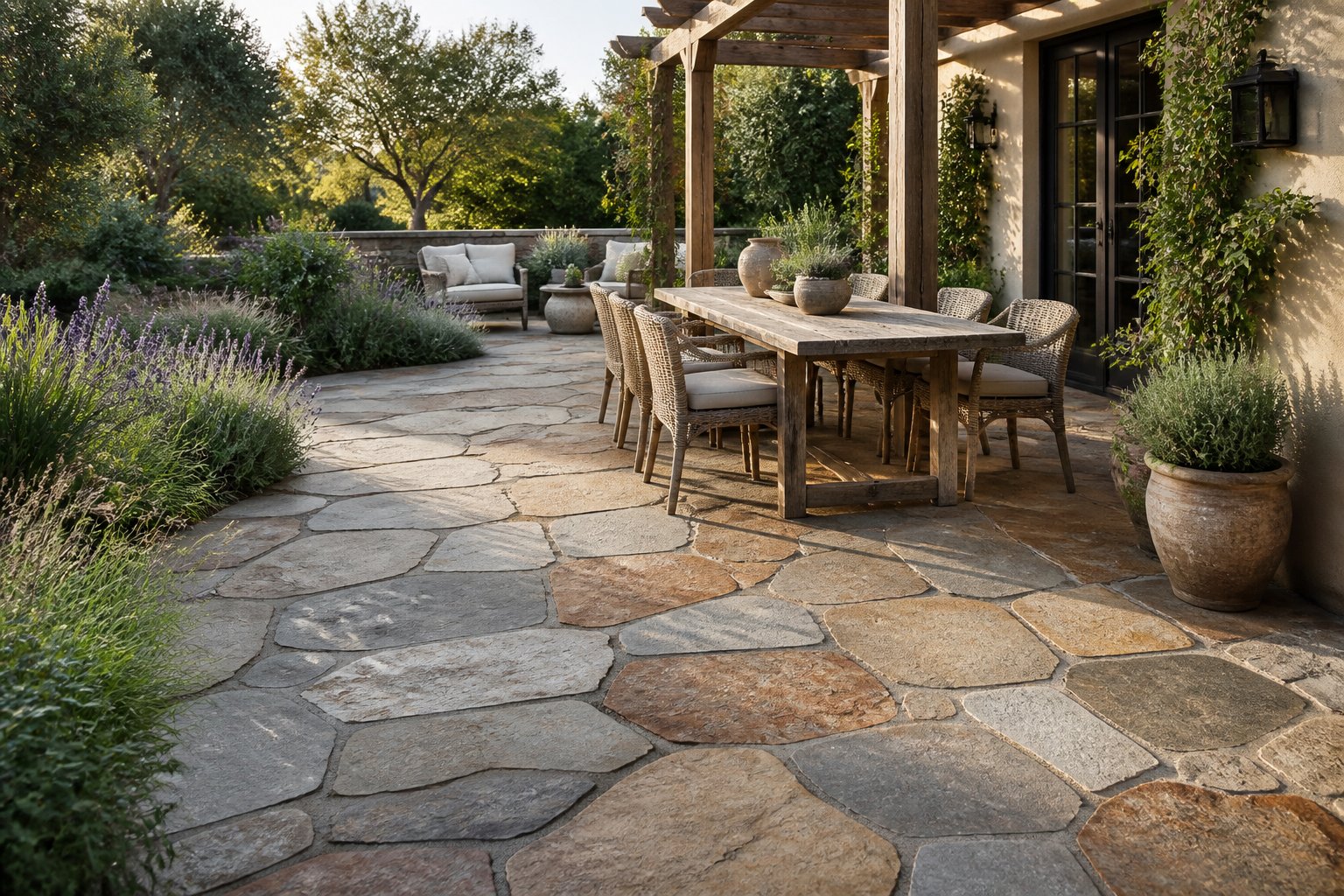
A pergola turns a hot afternoon slab into usable space. Set posts on footings poured below the flagstone base, not on top of the finished surface. Standard spans run 10 to 16 feet. A 12-by-16-foot footprint comfortably seats eight. Under shade, stone stays cooler and dries slower. Spec a dense reclaimed stone with low absorption to keep algae down where sun never fully reaches.
A Multi-Level Plan for Dining and Lounging
Grade change is a gift, not a problem. Two levels separated by three or four stone steps create a dining terrace above and a lounge below. No need for a single wall of furniture in between.
- Keep risers at 6 to 7 inches and treads at 12 inches minimum
- Use full 2.5-inch slabs for treads so edges never chip
- Face retaining walls with reclaimed brick for warmth against gray stone
- Run string lights or lanterns along the upper edge so the step reads at night
Reclaimed brick works well here. Our notes on reclaimed brick patios and walkways cover the transition detail.
A Large Outdoor Kitchen Surface With Durable Stone Transitions
Outdoor kitchens punish flooring. Grease, dropped cast iron, and constant foot traffic all land in the same three feet. Set that zone in mortar over a concrete slab instead of dry-laid sand. Choose a 1 to 1.5-inch stone since the slab carries the load.
Keep a visible break between the kitchen and dining zones. A soldier course of reclaimed brick, roughly 8 inches wide, marks the line and hides any thickness change. Softening the hard edges comes next.
Use Pathways, Planting, and Water to Soften the Stone
Stone alone reads cold. Pathways, plants, and moving water are what turn a patio into an outdoor living space you want to sit in.
Irregular Flagstone Pathways Through Garden Beds
Flagstone pathways should wander slightly, even over short runs. A dead-straight walk pulls the eye past the garden. Set stones 24 to 30 inches on center so a natural stride lands mid-slab.
Build the walk properly. Excavate at least 4 inches, line with landscape fabric, then compact the base. This Old House's flagstone walkway method specifies a 6-inch compacted base of 2-inch modified stone with 1 to 2 inches of masonry sand for leveling.
Water Features That Give a Stone Patio a Quieter Edge
A small fountain or a low waterfall spilling over reclaimed stone masks street noise better than any fence. Recirculating basins need 30 to 50 gallons minimum to run without constant topping off.
Set the feature at the patio edge with a river rock border. That transition zone handles splash without staining the field stone and keeps standing water off the walking surface.
Borders, Joints, and Lighting That Finish the Landscape
Joint fill changes both look and maintenance load:
- Polymeric sand: locks tight, resists weeds, needs replacement every 5 to 10 years
- Decomposed granite: permeable and warm-toned, needs occasional topping
- Grass or moss joints: softest look, requires trimming and irrigation
- Compacted gravel: best drainage, loosest feel underfoot
Low accent lighting washed across weathered stone shows off texture that daylight flattens. Hydrangeas and climbing vines finish the frame. None of it holds up without the right base underneath.
Plan the Base, Drainage, and Details That Protect the Investment
Base failure, not stone failure, is what ruins patios. Stone that survived 150 years in a European courtyard will outlast whatever you set it on.
Selecting Irregular, Mosaic, or Cut-Stone Flagstone Layouts
Irregular flagstone patio layouts use natural edges fitted like puzzle pieces, with 0.5- to 2-inch joints. It is the most forgiving pattern for reclaimed material because no two slabs need to match. Mosaic layouts trim edges for tighter fits, which costs more labor. Cut-stone grids need dimensional consistency that salvaged stone rarely provides.
Rustic flagstone patio work almost always means irregular. That is the honest expression of the material.
Preparing a Stable Base and Managing Water Runoff
Excavate 6 to 8 inches for dry-laid stone. Compact 4 to 6 inches of crushed base in 2-inch lifts, then screed 1 to 2 inches of sand. Slope the finished surface at least 1/8 inch per foot away from the house.
Permeable joints help. Per EPA guidance on reducing stormwater runoff, permeable pavers and open joints let water infiltrate instead of sheeting toward the foundation.
Allowing for Furniture, Pool Edges, and Seasonal Care
Around a pool deck or hot tub, specify thicker stone with textured faces and keep joints tight so bare feet stay comfortable. Chair legs need level slabs, so run a straightedge across the field before calling the job done.
Reclaimed stone asks for almost nothing seasonally. A sweep, an occasional rinse, and joint top-off every few years. Which leaves one question: whether the stone you want is actually available.
Confirm Reclaimed Stone Before the Project Schedule Tightens
Reclaimed inventory is finite. Every pallet of reclaimed European stone came out of a specific building. When that lot is gone, the color and wear pattern cannot be reordered.
That is the honest trade-off for authenticity. Homeowners searching for reclaimed stone near me often find nothing local, because salvage yards do not restock like a manufacturer. Nationwide freight solves the geography problem, with pallets shipped curbside by a freight carrier and a truck able to roll within 48 hours of a paid invoice.
Call early in the design phase, not after the base is compacted. A quick inventory check tells you the square footage on hand, current pricing, and whether you should plan a border of reclaimed brick pavers to stretch the stone across a larger footprint.
Stone With a Past, Ready for Your Backyard
The best patios are the ones that look like they were always there. Reclaimed stone gets you there on day one, because the wear is real and the patina was earned by a century of use.
Pick your material first. Build the base right, and let the layout follow. Whether you are specifying for a client or planning your own garden retreat, the decision that matters most is which stone goes down.
Call New Orleans Brick & Stone at 225-284-7529 today to check current reclaimed European stone inventory, confirm pricing, and get a truck moving within 48 hours of payment.
Frequently Asked Questions
How Much Does a Flagstone Patio Cost per Square Foot Installed?
Installed cost typically runs $18 to $40 per square foot, depending on stone type, thickness, and site access. Irregular layouts cost less in material but more in labor than cut-stone grids. Reclaimed stone pricing varies by what has been salvaged. Call for current numbers.
What Is the Best Base to Use Under a Flagstone Patio?
A compacted crushed-stone base of 4 to 6 inches, laid in 2-inch lifts, topped with 1 to 2 inches of masonry sand. That combination drains well and lets you level slabs without rocking. Skip the sand-only approach on clay soils.
Can Flagstone Be Installed Directly on Sand or Soil?
Stone set straight into topsoil will sink and create trip edges within a season or two. Sand alone offers no load distribution and washes out at the edges. Always compact a crushed base first. Even for a light-use walkway.
How Do You Keep Weeds From Growing Between Flagstone Joints?
Polymeric sand locks joints tight and blocks most seed germination for 5 to 10 years. Landscape fabric under the base helps but will not stop seeds landing on top. If you prefer moss or thyme joints, expect regular hand weeding.
Which Type of Flagstone Holds Up Best in Hot, Wet Weather?
Dense, tight-grained stone performs best. Reclaimed limestone and hard sandstone resist algae and surface pitting better than porous or soft slabs. Avoid polished finishes anywhere water collects. Since they turn slick fast.
How Often Does a Flagstone Patio Need Sealing or Maintenance?
Most natural stone patios never need sealing, and sealers can trap moisture in reclaimed material. Plan on sweeping, an annual rinse, and topping off joint fill every three to five years. That is the entire routine for dry-laid stone.