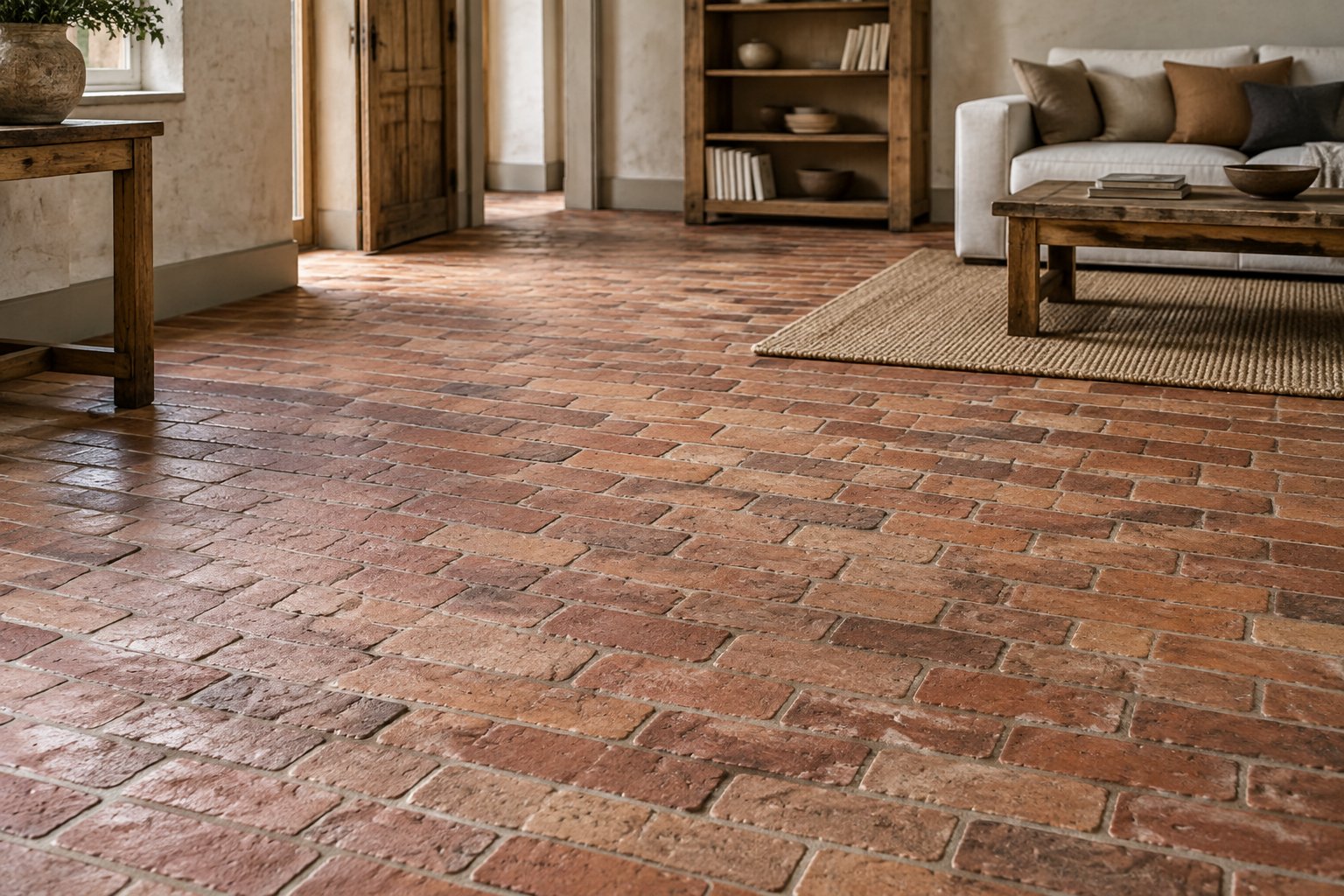
You are standing in a kitchen where the floor pulls every eye downward. The color shifts from burnt umber to dusty rose across every row. Each unit carries a slight irregularity in its edge, a surface worn smooth by a century of weather, and a warmth that no porcelain tile off a factory line will ever reproduce.
That is what bricks for flooring do to an interior space. They anchor a room in texture and history before the furniture even arrives.
New Orleans Brick Co supplies exactly these materials, reclaimed from structures over 100 years old, cleaned, sorted, and shipped nationwide within 48 hours of invoice payment. The Bourgeois family keeps inventory like Soft Reds and Hard Tans on hand, so your flooring project does not stall waiting on a six-month backorder.
Whether you are an architect specifying a period-correct mudroom floor or a homeowner dreaming about herringbone in the entryway, the material is real and ready.
Keep reading to learn which reclaimed brick types work best underfoot, how thin brick solves subfloor height problems, what sealing and mortar choices protect an interior installation, and how to confirm inventory before you commit. This guidance comes from working with these floors firsthand, not from a showroom brochure.
Why Reclaimed Brick Works Underfoot
Reclaimed brick earns its place on a floor because it has already proven it can last. A unit pulled from an 1890s warehouse wall has survived freeze-thaw cycles, structural loads, and over a century of exposure. That kind of proven durability gives you more confidence than any lab rating on a brand-new product.
How Authentic Patina Changes the Look of a Room
Patina is the visible record of age: mineral deposits, fire-kissing, subtle lime bloom, and color shifts created by decades of weather. On a floor, that variation means no two square feet look identical. The effect reads as organic rather than manufactured. This is why designers describe reclaimed brick floors as feeling "found" rather than "installed."
New brick can be tumbled or stained to suggest age, but the color sits on the surface. Authentic patina runs through the body of the brick. When you look at a reclaimed floor up close, you see tonal depth that a factory finish cannot achieve because it takes actual time and exposure to develop.
Where Manufactured Surfaces Fall Short
Porcelain tile printed to look like brick repeats the same three or four face patterns across an entire floor. Stand back five feet, and the repetition becomes obvious. Manufactured thin brick products offer slightly better variation, but the color range stays narrow because it comes from a single kiln run.
Reclaimed brick, by contrast, was made in small batches across different kilns, regions, and decades. A pallet of reclaimed red brick might include units ranging from deep burgundy to washed salmon. That range is the entire point. It is also the one thing a factory cannot replicate at scale.
Best Interior Spaces for Brick Floors
Bricks for flooring work hardest in spaces where you want warmth, texture, and durability to coexist. Entryways, mudrooms, kitchens, and hallways are natural fits because they handle heavy foot traffic and benefit from a surface that hides dirt between cleanings.
Sunrooms and covered porches also perform well because the thermal mass of brick helps regulate temperature swings.
- Entryways and mudrooms: high traffic, easy to sweep, hides tracked-in grit
- Kitchens: pairs with wood cabinetry and stone counters for a layered, historic feel
- Hallways: running bond or herringbone patterns draw the eye through the home
- Sunrooms: brick absorbs and releases heat slowly, keeping the room comfortable
- Wine cellars and basements: the mass and moisture tolerance suit below-grade spaces
The next question most builders ask is which type of reclaimed brick is right for a specific floor application.
Choosing the Right Bricks for Flooring
Your choice comes down to two variables: the look you want and the floor height you have to work with. Full-thickness pavers and thin brick each solve different problems. Picking the wrong one creates headaches at the transition threshold.
Soft Red and Hard Tan as Interior Flooring Options
Soft Reds are handmade bricks pulled from pre-industrial Southern structures. They carry irregular edges, subtle color variation from blush to deep clay, and a surface texture that feels warm underfoot. Their lower density makes them easier to cut on site, but they are more porous, so sealing is critical indoors. Soft Reds start at $1.85 per brick.
Hard Tans come from later-era machine-made buildings. They are denser, smoother, and more uniform in dimension. Their buff-to-golden color palette works well in modern interiors and transitional designs. Because of their higher hardness, Hard Tans resist wear in high-traffic corridors and kitchen floors better than softer handmade varieties, and they start at $2.00 per brick.
When Full-Thickness Brick Pavers Make Sense
A standard reclaimed brick paver runs roughly 2-1/4 inches thick. That thickness works best on a concrete slab at grade level where you can set the brick in a mortar bed without raising the finished floor above adjacent rooms.
New construction is ideal because you can plan the slab elevation to accommodate the full paver plus mortar.
If you are working in a renovation where floor heights are already set, a full paver may force you to notch door casings, raise thresholds, and adjust cabinet toe-kicks. That is not impossible, but it adds labor cost.
When Thin Brick Is the Better Specification
Thin brick tiles, typically cut to about 1/2 inch thick, let you get authentic reclaimed character on a floor without the height penalty. They install over plywood or concrete subfloors with thin set mortar, much like ceramic tile. The finished floor adds roughly 3/4 inch of total height once you factor in adhesive and grout.
Thin brick is the specification most architects reach for in second-floor applications and remodels where structural load and floor height matter. Because each piece is sliced from a full reclaimed brick, the face retains the same century-old patina as its parent unit.
Knowing which format fits your project raises the next practical concern: what you need to verify before you write a purchase order.
What to Check Before You Specify or Order
The details that derail a reclaimed brick floor project almost always trace back to something that could have been confirmed with one phone call before the order shipped.
Subfloor Height and Structural Considerations
Full-thickness pavers on a mortar bed weigh roughly 22 to 25 pounds per square foot when installed. Your slab or framed subfloor needs to support that load without deflection. On a wood-framed second floor, thin brick at roughly 4 to 6 pounds per square foot installed is the safer choice.
Measure your available height from subfloor to the bottom of the nearest door threshold. If you have less than one inch of clearance, thin brick is your only option without reworking transitions. If you have two inches or more, full pavers become viable.
Live Inventory, Lead Times, and Freight Planning
Many reclaimed brick suppliers quote lead times of 6 to 12 months. That timeline can wreck a construction schedule. Before you spec a material, confirm that the supplier actually has the quantity you need sitting on pallets, not listed in a future-availability catalog.
New Orleans Brick Co keeps live inventory on hand and ships on pallets via freight carrier. Once your invoice is paid, a truck can roll within 48 hours.
For a flooring project, calculate your square footage, add 10 percent for cuts and breakage, and call to confirm the count is available before you finalize your spec. Understanding the cost of reclaimed brick upfront prevents budget surprises.
How to Confirm Source Age, Sorting, and Condition
Ask your supplier three direct questions:
- What structure were these bricks pulled from, and how old is it?
- How are the bricks sorted: by color, by size, by condition, or all three?
- Have any units been tested for compressive strength or water absorption?
A reputable supplier will answer all three without hesitation. According to the National Park Service's guidance on historic masonry rehabilitation, verifying the origin and structural integrity of reclaimed materials is essential to responsible reuse.
Dimensional variation of up to 1/4 inch is normal in handmade reclaimed brick. That variation affects your grout joint width. This leads directly to the design decisions ahead.
Patterns, Finish, and Interior Design Effect
Layout pattern and grout color control the visual impact of a brick floor as much as the brick itself.
Herringbone, Running Bond, and Other Proven Layouts
A herringbone pattern creates strong visual movement and works well in entryways and kitchens where you want the floor to feel intentional.
Running bond, with staggered joints, is the simplest to install and reads as classic and calm. Basket weave alternates pairs of bricks at right angles and suits smaller rooms where herringbone might feel too busy.
Herringbone uses roughly 10 to 15 percent more material due to angled cuts at walls and borders. Factor that waste into your order quantity.
How Joint Width and Grout Color Affect the Overall Look
Wider joints, around 1/2 inch, emphasize each brick as an individual unit. Narrower joints, around 3/8 inch, make the floor read as a continuous surface. The dimensional variation in handmade reclaimed brick often requires wider joints anyway, so lean into that character rather than fighting it.
Grout color dramatically shifts the mood. A natural gray grout recedes and lets the brick dominate. A white or cream grout creates contrast and highlights the pattern. A dark charcoal grout adds a modern edge that pairs well with Hard Tan brick in contemporary spaces.
Matching Brick Character to Traditional and Modern Homes
Soft Reds with a warm gray grout in running bond feel at home in a traditional Southern residence inspired by the A. Hays Town philosophy of using reclaimed materials to create timeless interiors. Hard Tans with tight joints and a charcoal grout work in a modern farmhouse or loft conversion.
The key is matching the brick's surface character to the overall design vocabulary. A highly irregular, heavily patinated handmade brick in a sleek minimalist kitchen will feel like a mismatch. A smooth, uniform machine-made reclaimed brick in a historic cottage will feel sterile.
Once you have the pattern and aesthetic locked, the conversation moves to the practical side of keeping the floor looking good for decades.
Moisture, Sealing, and Long-Term Performance
Reclaimed brick is porous, and an interior floor needs a moisture management plan from the start.
Surface Preparation and Mortar Compatibility
On a concrete slab, apply a bonding agent or scratch coat before setting brick. Use a tile mortar rated for natural stone or masonry units. A standard thin set mortar rated for masonry works well for thin brick installations. Full-thickness pavers set in a traditional mortar bed need a Type S or Type N mix, depending on your region's requirements.
Make sure the slab is flat to within 1/4 inch over 10 feet. Any hump or dip will telegraph through the brick and create a trip hazard or a rocking unit.
Sealers, Grout Choices, and Indoor Durability
Seal the brick before grouting and again after grouting to prevent grout haze from staining the porous face. A penetrating silicate or siloxane sealer protects without changing the brick's natural appearance. Topical sealers add a sheen but can wear unevenly in high-traffic areas.
For grout, you have two main paths:
- Sanded grout: affordable, available in many colors, easy to work with, and suitable for joints over 1/8 inch. Needs sealing to resist staining.
- Epoxy grout: nearly impervious to moisture and staining. Ideal for kitchens and bathrooms, but harder to tool into the wide, irregular joints common with reclaimed brick.
Cleaning Expectations and How to Prevent Mold and Mildew
Sealed brick floors clean up with a damp mop and a pH-neutral cleaner. Avoid acidic cleaners; they can dissolve sanded grout and etch the brick surface over time.
To prevent mold and mildew, especially in bathrooms or humid climates, maintain the sealer on a two-year cycle and keep standing water off the surface. Good ventilation matters as much as the sealer itself.
If you are installing over a slab on grade, a moisture barrier beneath the mortar bed stops vapor transmission from becoming a long-term problem. With the technical side covered, the remaining question is speed: how fast can you get the material on site?
Getting the Look Without Slowing the Project
Material availability is the bottleneck that kills more flooring timelines than any installation issue.
How Fast Shipping Changes Material Decisions
When a supplier says "12-week lead time," your GC starts looking for alternatives. Reclaimed brick gets swapped out for manufactured tile because the schedule cannot absorb the wait. That compromise costs the project its character.
A nationwide reclaimed brick supplier with inventory on hand changes the math. If the material can ship within 48 hours and arrive on a freight truck within days, reclaimed brick becomes a viable specification even on tight timelines. That speed advantage is the reason builders keep coming back.
Questions to Ask Before You Place a Flooring Order
Before you commit, confirm these details with your supplier by phone:
- Do you have my full quantity available on pallets right now?
- What is the per-brick or per-square-foot price for the specific variety I need?
- Can I get photos or a sample of the current lot so I can verify the color range?
- What is the freight cost to my job site, and is delivery curbside or to the door?
- What is your policy if units arrive damaged?
These five questions protect you from surprises and give the supplier a chance to demonstrate they actually have what they are advertising.
When a Direct Inventory Call Saves Time
Email chains add days. A phone call to someone who can walk out to the yard and count pallets takes minutes. That is the advantage of working with a family operation where the person who answers the phone is the same person who inspects and ships the material.
If you are weighing used brick for sale from multiple sources, the supplier who gives you a straight answer on the first call is the one worth ordering from.
Frequently Asked Questions
Can standard wall brick hold up under foot traffic, or do you need pavers or thin brick?
Standard wall brick is typically softer and less dense than pavers. It can work in light-traffic areas, but for kitchens, hallways, and entryways, specify reclaimed pavers or thin brick rated for floor use. The higher compressive strength of pavers and the dimensional consistency of thin brick make them far better suited to daily wear.
What's the real installed cost per square foot once you factor in mortar, sealer, and labor?
Reclaimed brick flooring typically runs $12 to $20 per square foot installed, depending on the brick type, pattern complexity, and your region's labor rates. The brick itself starts around $1.70 to $2.00 per brick. Mortar, sealer, and grout add another $2 to $4 per square foot. Skilled mason labor accounts for the rest. Herringbone patterns cost more to install than running bond due to additional cuts.
What are the common downsides, and how do you head them off?
The main concerns are porosity, dimensional variation, and potential for cracking if the subfloor is not flat. You manage porosity with a quality penetrating sealer applied before and after grouting. Dimensional variation is handled by adjusting joint width. Subfloor flatness should be checked with a straightedge before any mortar goes down.
Is this a good choice for kitchens and bathrooms, or will water and stains be a constant fight?
Sealed reclaimed brick performs well in kitchens and bathrooms as long as you maintain the sealer every two years and wipe up standing water promptly. Epoxy grout in wet areas gives you an extra layer of moisture protection. The surface hides minor stains better than white tile ever will.
How do you prep a slab or wood subfloor so the brick doesn't shift or telegraph every hump?
On concrete, grind down high spots and fill low spots with a self-leveling compound so the surface is flat to within 1/4 inch over 10 feet. On a wood subfloor, install 1/2-inch cement backer board screwed at 6-inch intervals. This prevents flex and gives the thin set mortar a stable bond surface. A guide on how to install reclaimed bricks covers additional prep steps.
Where can you source reclaimed brick for an interior floor, and what's a typical lead time to get it delivered?
Look for suppliers who source from verified 100-plus-year-old structures and keep sorted inventory on hand. Reputable suppliers with sorted inventory ship palletized reclaimed brick nationwide within 48 hours of payment, compared to the 6 to 12-month waits common elsewhere. Call directly to confirm the variety and quantity you need before placing your order.
Your Next Step Is a Phone Call, Not a Catalog
Reclaimed brick gives an interior floor something no manufactured product can: real history, proven durability, and a surface that gets more interesting over time.
Whether you are specifying Soft Reds for a traditional Southern kitchen or Hard Tans for a modern entryway, the material decision matters less than confirming it is actually available when your project needs it.
Call New Orleans Brick Co at the number on the site and ask which reclaimed brick is available for your floor. If your timeline is tight, they can have material on a truck within 48 hours of payment. You will get a straight answer on availability, pricing, and freight from someone who has handled these bricks by hand.