A patio needs to go in before the weather turns, and the drawing is waiting on one decision: which brick. That single choice changes the pattern you can run, the joint width you can hold, and the number of cuts your mason has to make on site.
Most old brick patio ideas fail at that point, because the design gets finalized first and the material gets chosen second. Reclaimed brick does not work that way. Old bricks come with a size range, a color range, and a wear history that the layout has to respect.
The good news is that the constraint is also the reason people want reclaimed brick in the first place. Weathered brick carries kiln marks, mortar shadow, and softened edges that no new paver reproduces. Aged brick pulled from buildings more than a century old also tends to be dense. Hard-fired clay that has already survived a hundred freeze cycles outdoors.
Keep reading to learn which reclaimed materials suit which patio styles, which patterns show off variation instead of fighting it, how to build outdoor rooms around a brick surface, and how to prep a base that holds for decades. After forty years of handling this material, the honest advice is simple: pick the brick, then draw the patio.
Old Brick Patio Ideas by Material Character
The brick you choose sets the mood of the whole outdoor space before a single joint is filled. Color, hardness, and surface texture vary a lot between reclaimed types, and each one produces a different patio design.
Most reclaimed pavers run close to standard brick dimensions, roughly 8 inches by 3 3/4 inches by 2 1/4 inches, but salvaged stock varies by an eighth of an inch or more. That variation is normal. It also means your pattern and joint width need a little tolerance built in.
Soft Red Brick for Cottage-Style Gathering Spaces
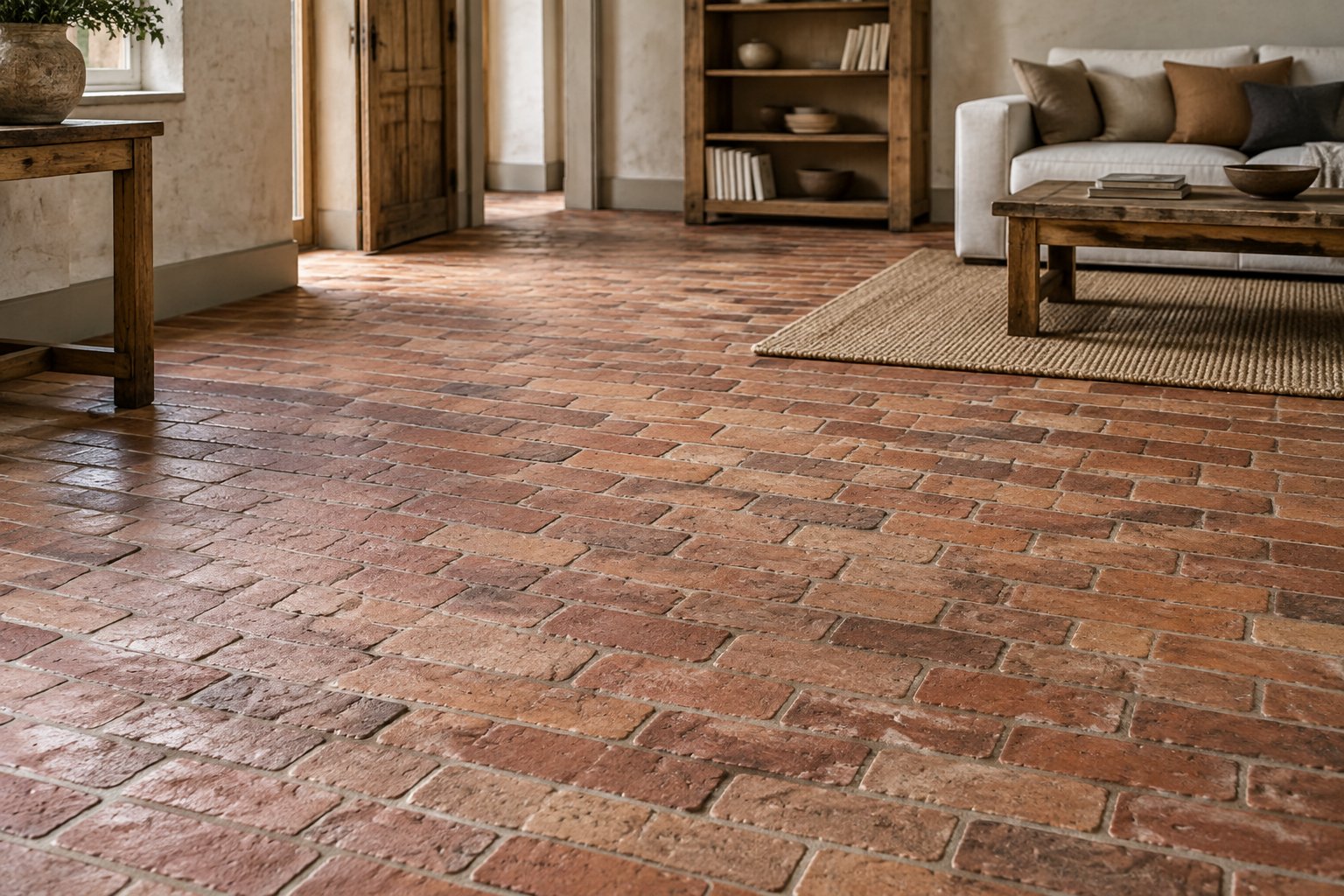
Soft Reds come from pre-industrial and early industrial buildings, and they read warm, chalky, and slightly uneven. Edges are rounded from handling and weather. Laid in a field, they give the soft, faded look of a European courtyard rather than a new red brick patio.
Because reclaimed soft red bricks are more porous, they suit lower-traffic patios, seating nooks, and shaded garden areas. Set them tight on a compacted base with a generous sand bed so no single unit takes the full load. Pair them with reclaimed wood benches or bluestone steps for contrast.
Hard Tan Brick for Durable, Warm-Toned Terraces
Hard Tans are the workhorse. Fired hotter and denser, they hold up under furniture legs, grills, and daily foot traffic without spalling. The color runs buff, sand, and pale gold with darker flashing across the face.
Use Hard Tans where a terrace connects to a driveway, a pool deck, or an entry walk. They also cut cleaner than softer brick, which matters when you have curves or borders.
Old Chicagos for a Deeply Varied Courtyard Surface
Old Chicago brick pavers carry the most variation of any common reclaimed type: reds, browns, purples, blacks, and streaks of old mortar left on the face. Spread across a large field, that mix reads as depth rather than noise.
Old Chicagos are best on patios of 300 square feet or more where the color range has room to blend. Blend from at least three pallets as you lay, or you will get visible color bands.
St. Louis Reds for Traditional Patio Fields and Borders
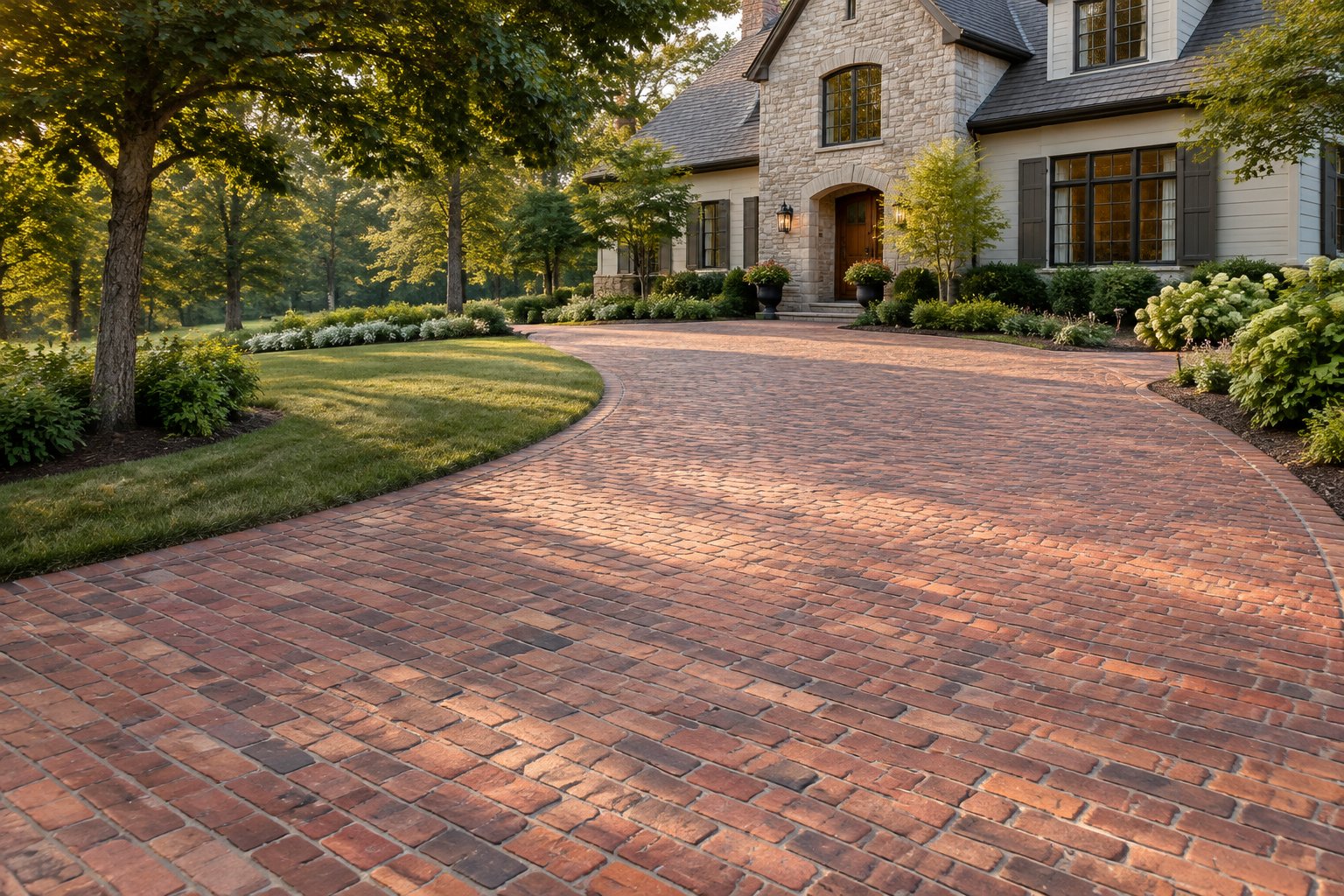
St. Louis Reds are the classic choice when you want a true red brick patio with historic weight. Color is more consistent than Old Chicagos but still varies enough to look salvaged, not manufactured.
They work well as a soldier-course border around a mixed field, framing weathered bricks in the center. That border also gives the mason a clean edge to work toward. Once the material is settled, the pattern decides how much of that character actually shows.
Pattern-Led Layouts That Let Reclaimed Brick Show Its Age
Pattern controls how the eye reads color variation and size difference. Tighter, more repetitive patterns hide irregularity. Bolder patterns put it on display. Here is how the common layouts compare on a reclaimed brick patio:
- Herringbone: strongest interlock, most cuts, hides size variation well
- Running bond: fewest cuts, easy on narrow spaces, shows any size drift
- Basketweave: needs bricks close to a 2:1 length-to-width ratio
- Pinwheel: requires a half-brick or square center piece, slower to lay
- Circular: most waste, most cutting, best with a mixed-color brick
Herringbone Fields for High-Traffic Outdoor Living
A herringbone brick patio locks each unit against its neighbors, which resists shifting under furniture and foot traffic. Run it at 45 degrees to the house for the strongest visual line.
Brick mason Terry McGovern, working on a herringbone brick patio project, called it the oldest pattern known to brick paving and recommended stringing a center line as a spine. Expect 5 to 10 percent extra material for perimeter cuts. Order accordingly.
Running Bond for Narrow Patios and Connecting Walkways
Running bond is the fastest pattern to lay and the most forgiving in tight spaces. Run the long dimension along the direction of travel to make a narrow patio feel longer. Because a running bond pattern lines up every other joint, size differences show. Sort your pallet by length first and keep the outliers for borders or cuts.
Basketweave and Pinwheel Patterns for Cottage Gardens
Basketweave pairs two bricks flat against two turned 90 degrees. It reads calm and traditional, and it suits Soft Reds in a cottage garden setting. A pinwheel pattern wraps four bricks around a center square. Cut half-bricks for those centers, or use a contrasting color for a subtle checkerboard effect.
Circular Medallions for Fire Pit-Centered Patios
A circular brick patio medallion works best when it has a purpose, usually a fire pit or a fountain at the center. Lay the rings first, then fill the surrounding field. Old Chicago's suit circles because the color mix disguises the wedge cuts. Budget for 15 percent waste on tight radii.
Geometric and Checkerboard Designs for More Modern Homes
Geometric brick patio layouts pair a brick field with bands of bluestone or gravel. The straight lines read modern while the brick keeps the warmth. Keep the grid simple and let the material carry the texture. With the surface pattern set, the next question is what you build on top of it.
Outdoor Rooms Built Around a Brick Surface
A brick patio is a floor. What turns it into an outdoor living space is what sits on it and around it.
A Fire Pit Circle With Safe Materials and Comfortable Seating
Use fire-rated bricks or firebrick for the inner wall of any brick fire pit. Reclaimed pavers work fine for the outer face and the surrounding surface, but they should not line a burn chamber directly. Leave 5 to 6 feet of clear brick between the pit edge and seating. A sunken fire pit or conversation pit adds shelter from the wind on open lots.
A Pergola-Covered Dining Patio With Evening Lighting
Set pergola posts on footings that go below the frost line, not on the brick field. Cut the brick around the post base so the surface stays continuous. String lights along the wooden pergola rafters give warm, low light that flatters weathered brick at night. A long wooden dining table and outdoor rugs finish the room.
An Outdoor Kitchen With a Built-In Grill and Service Space
Build the grill surround on its own concrete footing. Then clad it with reclaimed brick so the counter and the patio read as one material. Allow 24 to 36 inches of counter on each side of a built-in grill for real working space.
Sunken and Multi-Level Designs for Sloped Yards
On a grade, brick terraces beat one large flat pad. Step down in 6- to 8-inch rises using reclaimed brick risers over a block core. Retaining walls on the high side need drainage behind them. Gravel backfill and a perforated pipe prevent hydrostatic pressure from pushing the wall out.
Quiet Garden Patios With Water and Shade Features
A small water feature, a bird bath, or a cascading waterfall gives a quiet patio a focal point. Adirondack chairs, a hammock, or a porch swing keep the scale intimate. These smaller garden patios often lead straight into planting beds, which is where brick and landscape start to blend.
Extending the Patio Into the Garden
The same brick that forms the patio should carry into paths, beds, and edging. That repetition is what makes a reclaimed brick hardscape feel like it grew with the house.
Winding Brick Paths That Tie the Patio to the Landscape
A winding brick pathway 36 to 48 inches wide handles two people walking side by side. Narrower paths at 24 to 30 inches suit service routes to a shed or herb garden. Running bond or a simple soldier course works best on curves because it needs fewer cuts. Use the same reclaimed brick as the patio so the transition disappears.
Raised Brick Beds for Herbs, Flowers, and Seasonal Color
Brick raised beds at 18 to 24 inches tall are comfortable to work in without kneeling. Lay them dry-stacked over a gravel footing for informal beds, or mortar them for permanence. Line the interior face with landscape fabric to slow moisture transfer into the brick. That extends the life of softer reclaimed units in constant contact with soil.
Retaining Walls, Planter Boxes, and Edging With Salvaged Brick
Brick edging set on end, buried two-thirds deep, holds a gravel area or garden bed cleanly. It also keeps the patio field from creeping outward over the years. For low retaining walls under 3 feet, harder reclaimed brick is the safer pick. Use these guidelines when placing bricks outside the patio field:
- Soil contact and beds: dense, hard-fired brick only
- Vertical edging: any reclaimed brick, set deep
- Low walls under 3 feet: hard brick over a compacted gravel base
- Walls over 3 feet: engineered core with brick facing
Plant Pairings That Soften a Historic Brick Hardscape
Creeping thyme, moss, and low sedum fill joints and soften a new install fast. Climbing vines on a pergola or wall add height without taking floor space. Cottage garden plantings, potted plants, and a reclaimed wood bench all read well against aged brick. None of it matters, though, if the base underneath fails.
Build for Drainage, Movement, and Long-Term Character
Brick patio installation lives or dies on the base. Reclaimed brick is durable, but it will move if the ground under it does.
Setting Reclaimed Brick on a Properly Compacted Base
Excavate 8 to 10 inches for a patio in a freeze climate, and 6 inches in mild regions. Fill with crushed gravel and compact in 3-inch lifts, not all at once. Top with 1 inch of bedding sand, screeded flat. Slope the finished surface 1/8 to 1/4 inch per foot away from the house.
Choosing Joint Material and Managing Weed Growth
Polymeric sand hardens after wetting and blocks most weed growth. Sweep it dry, remove every grain from the brick face, then mist lightly. On softer reclaimed brick, some installers prefer plain sand or a fine gravel joint because it moves with the brick instead of cracking against it.
Allowing for Color Variation, Wear, and Future Repairs
Reclaimed brick will keep changing. Color deepens, joints settle, and edges soften further. That is the character you paid for. Order 5 to 10 percent extra and store the surplus dry. Matching salvaged brick years later is rarely possible.
Matching the Design to Live Material Availability
Reclaimed stock is finite by nature. A pattern that needs 4,000 matched Old Chicagos only works if 4,000 are on the yard. Confirm quantity before your mason breaks ground. That confirmation should happen before the drawing is final.
Choose the Brick Before Finalizing the Drawing
Reclaimed brick is not a spec you fill in later. The material dictates joint width, cut count, and pattern feasibility.
Confirming Quantity, Condition, and Color Range Before Layout
Ask for actual dimensions, not nominal ones. Ask how many pallets are on hand. A pallet typically covers 60 to 80 square feet of patio, depending on brick size and joint width.
Ask whether the brick is cleaned. Ask how much mortar residue remains. Understanding how to choose reclaimed bricks before you order saves rework on site.
Getting Material-Specific Guidance for a Reclaimed Patio
Different reclaimed types behave differently under weather and traffic. Comparing reclaimed brick pavers side by side against used brick for sale options tells you what your budget actually buys.
A ten-minute phone call answers more than a week of emails. That is usually the fastest way to lock a patio design.
Frequently Asked Questions
How Can I Build a Reclaimed Brick Patio on a Budget?
Reclaimed brick often runs less per unit than new pavers, with salvaged brick reported around $0.45 to $0.50 each versus roughly $0.80 for new. Buying uncleaned brick lowers cost further if you are willing to do the cleaning yourself. Keep the layout to running bond to cut labor and waste.
What Does a Reclaimed Brick Patio Typically Cost per Square Foot?
Material alone commonly lands between $4 and $9 per square foot, depending on brick type and joint width. The installed cost with base prep, edging, and labor usually runs higher. Ask for per-brick pricing and pallet coverage to compare accurately.
Which Brick Patterns Work Best for a Small Patio?
Running bond laid along the long axis makes a small space read longer. Herringbone also works well because the diagonal draws the eye across the full width. Avoid large circular medallions. These waste materials are on small pads.
How Do I Choose Authentic Old Bricks That Will Hold Up Outdoors?
Look for dense, hard-fired brick with a solid ring when tapped, not a dull thud. Check for deep cracks, heavy spalling, and crumbling faces. Bricks from century-old structures that have already survived outdoor exposure are usually safe bets.
Can Reclaimed Bricks Create a Clean, Modern Patio Design?
Yes. Hard Tans or sorted St. Louis Reds in a tight running bond with narrow joints read crisp and contemporary. Pair the brick field with bluestone bands or a gravel border to sharpen the geometry.
What Base and Drainage Preparation Does a Brick Patio Need?
Plan on 6 to 10 inches of compacted crushed gravel, laid in 3-inch lifts, plus 1 inch of bedding sand. Slope the surface at least 1/8 inch per foot away from the house. Add drainage behind any retaining wall on a sloped lot.
Pick the Material First, Then Draw the Patio
Every idea above depends on one thing: knowing exactly what brick you have and how much of it. Soft Reds, Hard Tans, Old Chicagos, and St. Louis Reds each produce a different patio. None of them exist in unlimited quantity.
If you are finalizing a layout this season, confirm the stock before the drawing goes final. Call New Orleans Brick & Stone at 225-284-7529 to check what is on the yard today, get real per-brick pricing, and get a truck moving within 48 hours of payment.
You will talk to someone who has handled the material. They can tell you what a pallet actually covers and can say plainly whether your pattern will work with what is available.