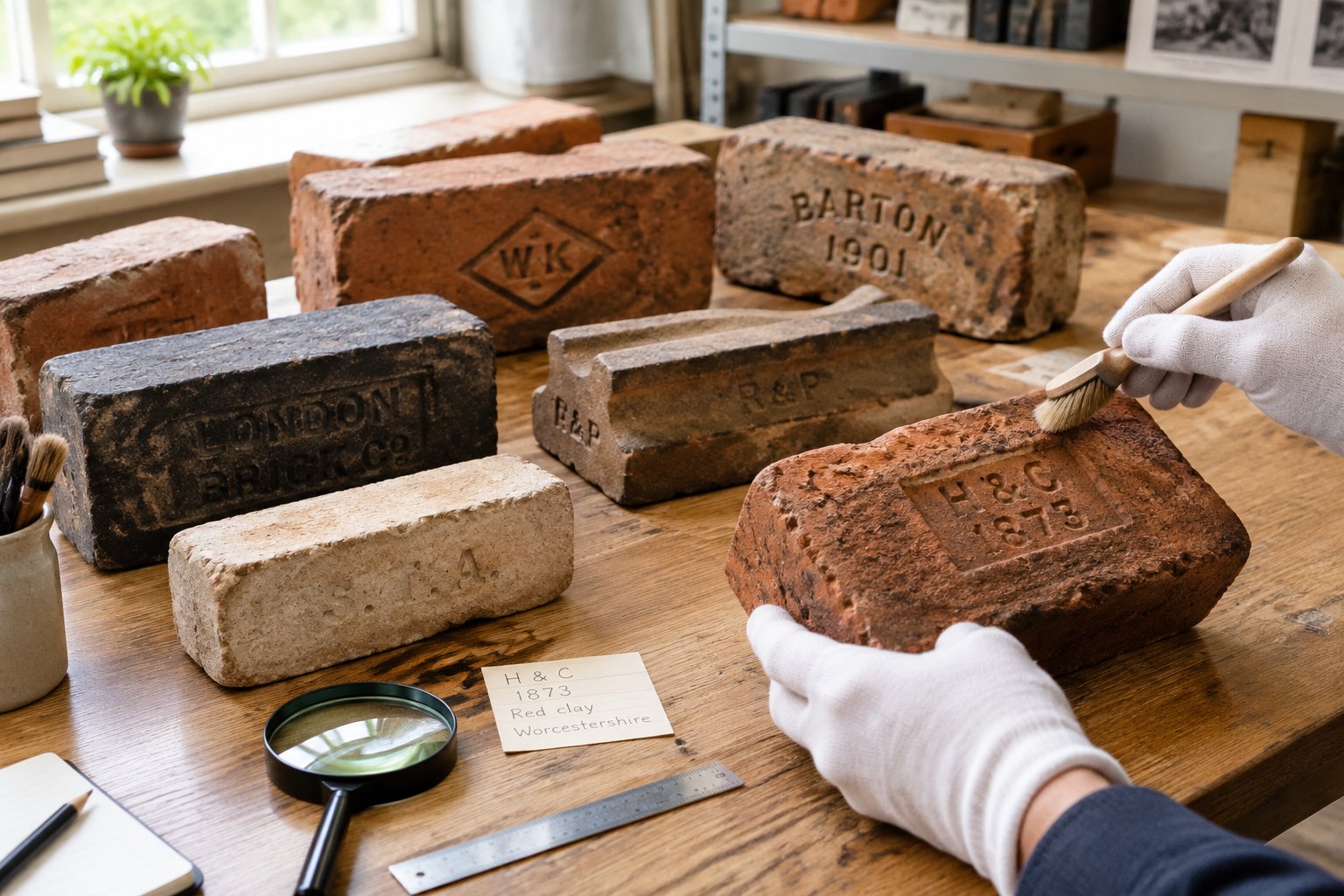
A stamped name in the frog of an old brick points to a brickyard, a town, and quite often a family business that closed three generations ago. Once you can read those clues, a pile of demolition rubble stops being rubble and starts being an archive.
The hobby rewards patience far more than money. Most collectors find their bricks for free, trade their duplicates, and spend the real effort on research. Brick history in this country is stubbornly local, and a great deal of it survives nowhere except in the bricks themselves and in the notebooks of the people who collect them.
What makes a brick worth keeping
Information you can trace. A name, initials, a city, a design pressed into the clay.
The maker's mark is the heart of it. Brickyards stamped company names, initials and sometimes a location into the face or the frog, which is the shallow dip on one side, and those stamps are what make a given factory's output identifiable a century later.
The lettering is a pleasure in its own right. Late nineteenth century stamps quite often show a reversed N or S, because the mold maker had to carve the letters backwards and occasionally did not. A backward letter is a small human error that collectors go out of their way to find. Beyond lettering you will come across dates, patterns, stars, pictures, and on paving brick, raised lugs and buttons. Any of it gives a brick a personality that a plain common brick simply does not have.
Rarity follows geography. A brick from a large yard that shipped millions turns up everywhere, while a brick from a small rural works that ran for a decade may only ever surface within twenty miles of where it was made. Defunct makers and bricks from known historic buildings attract the most interest.
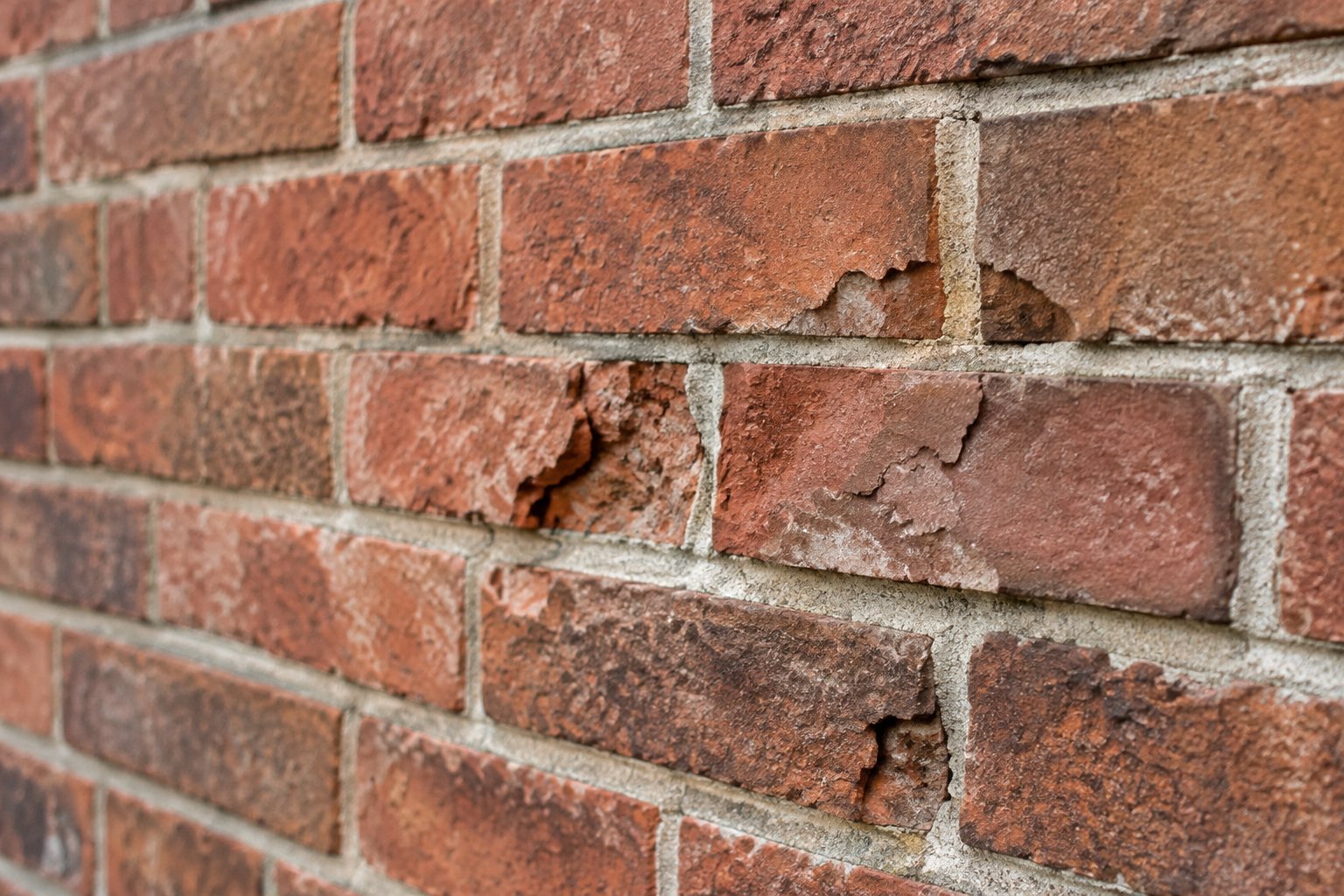
Condition matters too: intact edges and corners, a legible mark, little mortar residue, no paint, no salt damage or spalling. And documented origin is worth as much as any of it, because a brick with a note recording which building it came out of and when is worth considerably more to a researcher than the identical brick with no history attached.
Pick a focus early
Bricks weigh four and a half to five pounds each, which concentrates the mind. Most collectors start with their own state or county, or pick one category such as paving brick, firebrick, or the yards along a single river valley. Some collect by typography or by color.
A narrow focus also makes the research possible. Collect Louisiana yards and you learn the clay colors, the common stamps and the local historians who can answer questions. Your collection gets deeper rather than merely heavier, and your trades improve because you know precisely what you are missing.
Identifying what you have found
Photograph before you clean anything. Shoot the stamp in low side light, which throws shallow letters into relief better than direct light ever will, then the frog, both long faces, an end and the underside, with a tape in frame throughout.
Measure length, width and height carefully, and measure more than one brick from the same site if you can, because old bricks vary within a single batch. Note the color, any iron spots, pebbles in the clay, and whether the surface shows sand or a smooth wet-struck finish. Those details are what let somebody else identify a brick you cannot.
Manufacturing clues give you a period rather than a date. Before about 1870 most American brick was hand-molded in wooden forms, so it shows uneven texture, finger marks and soft edges, while the machine-pressed brick that followed has sharper edges and far more consistent sizing. Size helps too, with pre-1900 brick often running around 8 5/8 by 4 by 2 1/2 inches against a modern standard nearer 8 by 3 5/8 by 2 1/4.
Treat every clue as a range rather than an answer, because the technology spread at wildly different speeds and a rural yard might have been hand-molding long after the city yards had presses. If you want to sharpen your eye for genuine age, the signs of authentic antique brick overlap almost entirely with what collectors look for.
Researching the mark
Brick indexes let you match a stamp against thousands of recorded marks. The Old Bricks catalog compiled by David Kitching covers named British bricks by maker, and for American marks the International Brick Collectors Association maintains a searchable brick name database whose volunteers actively welcome photographs of unidentified finds.
Back any index match up with records. City directories, county histories, old fire insurance maps, newspaper advertisements and state geological surveys all list brickyards by name and location, and local historical societies frequently hold the best material of all. The method is worth seeing in action: a brick stamped N.I.P. with a backward N, found in Newburgh, New York, was traced by one collector to Norton I. Pennock, listed as a brick manufacturer in Poughkeepsie directories from 1914 to 1928. Index, then directory, then date range.
Regional color is a clue in itself, which is how collectors separate one Midwestern yard from another by reading St. Louis brick markings and color, and how an unstamped yellow Old Chicago brick can still be placed by its clay alone. New England brick tends dark red with visible sand striking, and old mill towns in Massachusetts and Connecticut turn up nineteenth century stamps in quantity.
Finding them, and finding other collectors
Demolition sites and salvage yards are the richest hunting grounds by a wide margin, and a great many marked bricks would otherwise go straight into crushed fill. Ask the site manager or the owner before you take anything, every single time, and wear gloves, boots and eye protection while you are there.
Old brickworks, factory sites and eroded riverbanks are all productive, and so are old landfill sites and coastal rubble. What is never acceptable is taking brick from a standing historic building, a garden wall or a protected site, and the hobby's reputation with the people who control access depends entirely on collectors not doing it. Some collectors sidestep the issue altogether by building a photographic collection, which weighs nothing and needs no permission beyond access.
The knowledge lives in the groups. The International Brick Collectors Association is the main American club, running sanctioned swaps three times a year in different locations and publishing a journal with identification help, and its culture leans heavily toward trading rather than selling among members. There are active collector groups on Facebook and a brick collectors community on Reddit for posting finds. Brick museums tie the hobby back to the industry, and the British Brick Society, founded in 1972, has been studying brickmaking and brickwork for over fifty years.
For a new collector, a swap is far and away the fastest route to filling gaps and learning which marks are genuinely scarce rather than merely unfamiliar. Historical societies also run talks where you meet older collectors who remember yards that closed before you were born.
Cleaning, cataloguing and storage
Clean lightly. A stamp damaged by aggressive cleaning loses most of its research value permanently, and old brick is usually softer than modern brick because it was fired at lower temperatures, with a thin fired skin that takes the letters with it when it goes.
Start with a dry soft brush, which is frequently enough. If you need water, use clean water and a nail brush and let the brick dry slowly in shade. Pick loose mortar out of the stamp with a wooden skewer or a plastic tool, and keep wire brushes, pressure washers and acid away from the marked face entirely.
Know when to stop, too. A smear of old lime mortar shows how the brick was laid and proves it came out of a wall, so if it is not covering the mark, leave it. Hard cement is a harder call, and if it hides the lettering, tap gently at the joint line working away from the mark and stop the moment the brick begins to flake. Soot, paint drips and old whitewash are part of the history as well, so record them before deciding to remove anything.
Then catalog properly, because a brick without notes is just a heavy object. Number each one and log it the day you find it: location, date, building if known, who gave permission, dimensions, color, stamp text and your photographs, with the number written on the underside in pencil or archival ink.
Add a confidence level to every identification. "Confirmed by directory listing" means something very different from "matched by eye to a photograph online", and recording which is which stops errors propagating when you trade or publish. It is the same principle that makes reclaimed materials tell a story at all: the material is only as good as the record behind it.
Store dry and off the ground, because moisture and freeze cycles split old brick and salts in damp bricks push out through the face. Sturdy crates, pallet racks or steel shelving rated for the weight all work. For display, stamps facing out at eye level with the heaviest pieces low down, and anchor tall shelves to the wall, because a loaded brick shelf is genuinely dangerous. Plenty of collectors build a garden path out of duplicates and keep the best examples indoors where weather cannot wear the letters away.
A standing offer
We handle a great deal of salvaged brick and we see stamps constantly, including plenty we cannot place. Collectors are welcome to ask.
If you have a mark you cannot identify, send a photograph taken in daylight with a coin or a tape in the frame to hays@bourgeoismaterials.com and we will tell you if we recognize it. We make no promises, but between the yard and the people we buy from, somebody often does.
And if a collection has outgrown the garage, or a demolition has turned up more brick than you want to keep, that is worth a conversation too. Sound reclaimed brick in quantity is building material rather than shelf material, and it is better in a wall than in a skip.
Call the New Orleans office on 225-284-7529 if you want to talk it through.
Frequently asked questions
Are old bricks worth money?
Most are worth a few dollars at most, with identified antique bricks broadly running $1 to $5 each. Rare stamps, decorative designs and bricks tied to famous buildings go higher. Among collectors, a brick is mostly worth another brick.
How do I find other collectors?
Start with the International Brick Collectors Association, its swaps and its online groups, then local historical societies and brick museums. Asking at salvage yards works surprisingly well, since collectors tend to be regulars there.
How do I identify a brick with no mark?
Measure it, then read the texture, color and inclusions. Finger marks and uneven edges point to hand-molding and an earlier period, sharp edges and consistent sizing to machine pressing. Clay color narrows the region, and the building it came from usually answers the rest.
Does a stamp prove the age?
It gives you the maker, and the maker's years of operation give you a range. Plenty of yards used one stamp for decades, so a stamp alone rarely pins a year. Combine it with size, surface and building records.
What should I do with duplicates?
Trade them, which is how most collections actually grow. Beyond that, plain sound brick in any volume is building material and better used than stored.