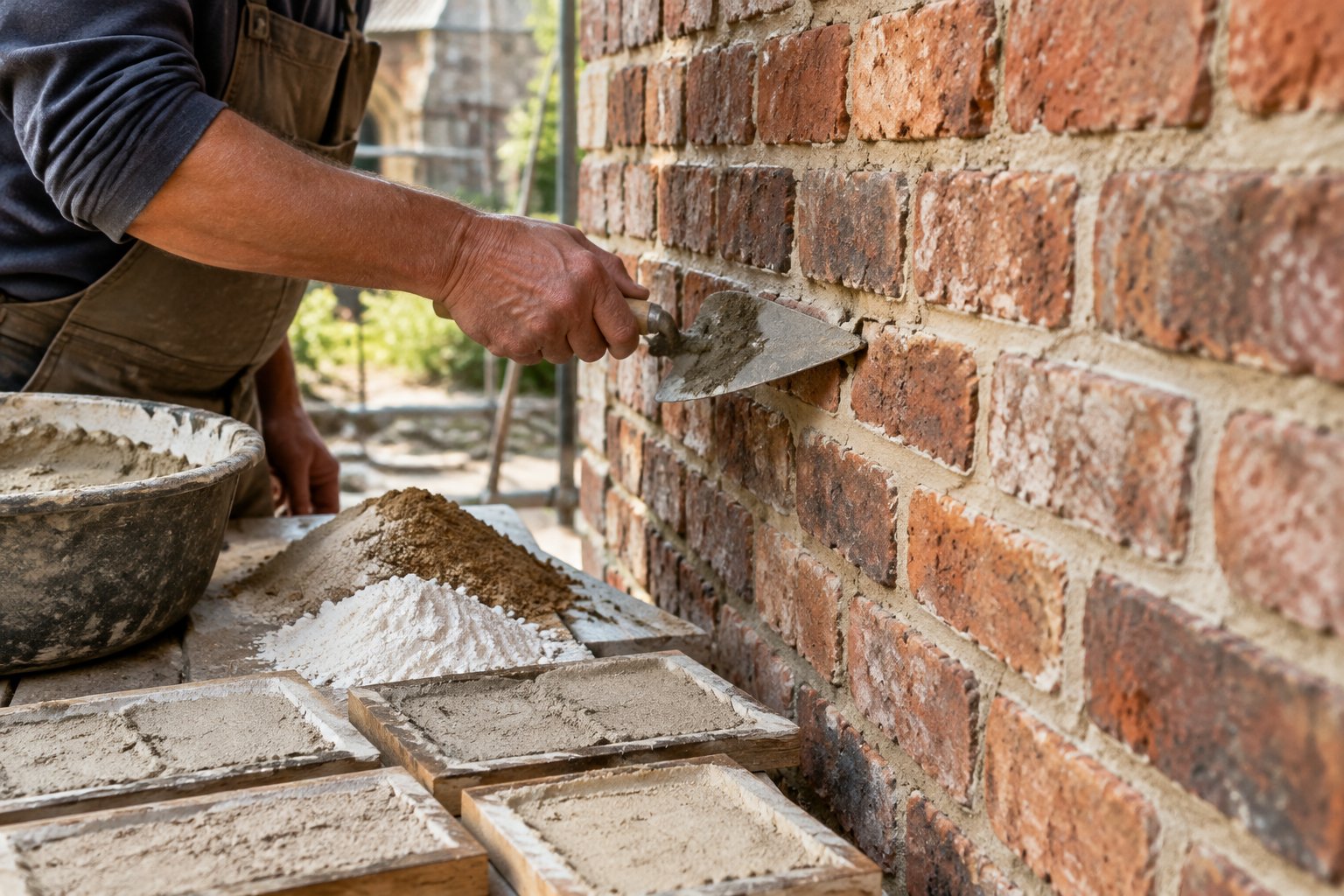
Lime, sand and water. That is the whole recipe, and for soft pre-1900 brick it is still the right one, because the mortar it makes stays softer and more breathable than the brick it holds. That single property decides whether moisture leaves a wall through its joints or takes the face off the brick on the way out.
If bagged cement mix is all you have ever used, lime will feel slow and faintly ridiculous. It sets over weeks rather than hours. It wants shade, damp burlap and somebody paying attention to it for days after the mason has gone home. What you get for that trouble is a wall where the joints wear out and the brick does not, which is the entire point.
The same logic applies to new work built from reclaimed brick. Century-old brick was fired softer than anything coming out of a modern kiln and it was laid in lime. Give it the right mortar and the wall ages the way the original did. Give it hard cement and you can lose the faces off brick you paid good money for.
What each ingredient is actually doing
Lime is the binder. It coats the sand grains and hardens slowly back toward limestone, which is where it came from. Sand does most of the structural work: the grains lock against each other and set the color and texture of the finished joint. Water makes the thing workable and starts the reaction, then leaves.
With lime putty mortars in particular the sand carries most of the compressive strength, which makes choosing sand a bigger decision than a lot of masons expect. It is not filler.
The joint is supposed to be sacrificial
Mortar is the part of a wall you plan to replace. It sits as a soft, breathable layer between hard units, so when the building shifts the joint takes the stress, and when water gets in the joint is how it leaves. GSA preservation guidance states the principle directly: when the repointing mortar is softer than the masonry, the deterioration happens in the mortar, which is the cheap thing to replace.
Repointing a wall every few decades is routine maintenance. Cutting spalled brick out of a historic facade is a different order of job and cost.
Where Portland cement goes wrong
Cement mortar is harder, denser and far less breathable. Lime putty mortars carry a vapor perm rating usually in the seventies. Ordinary Portland mortars sit in the twenties and run somewhere between 1,500 and 2,500 psi.
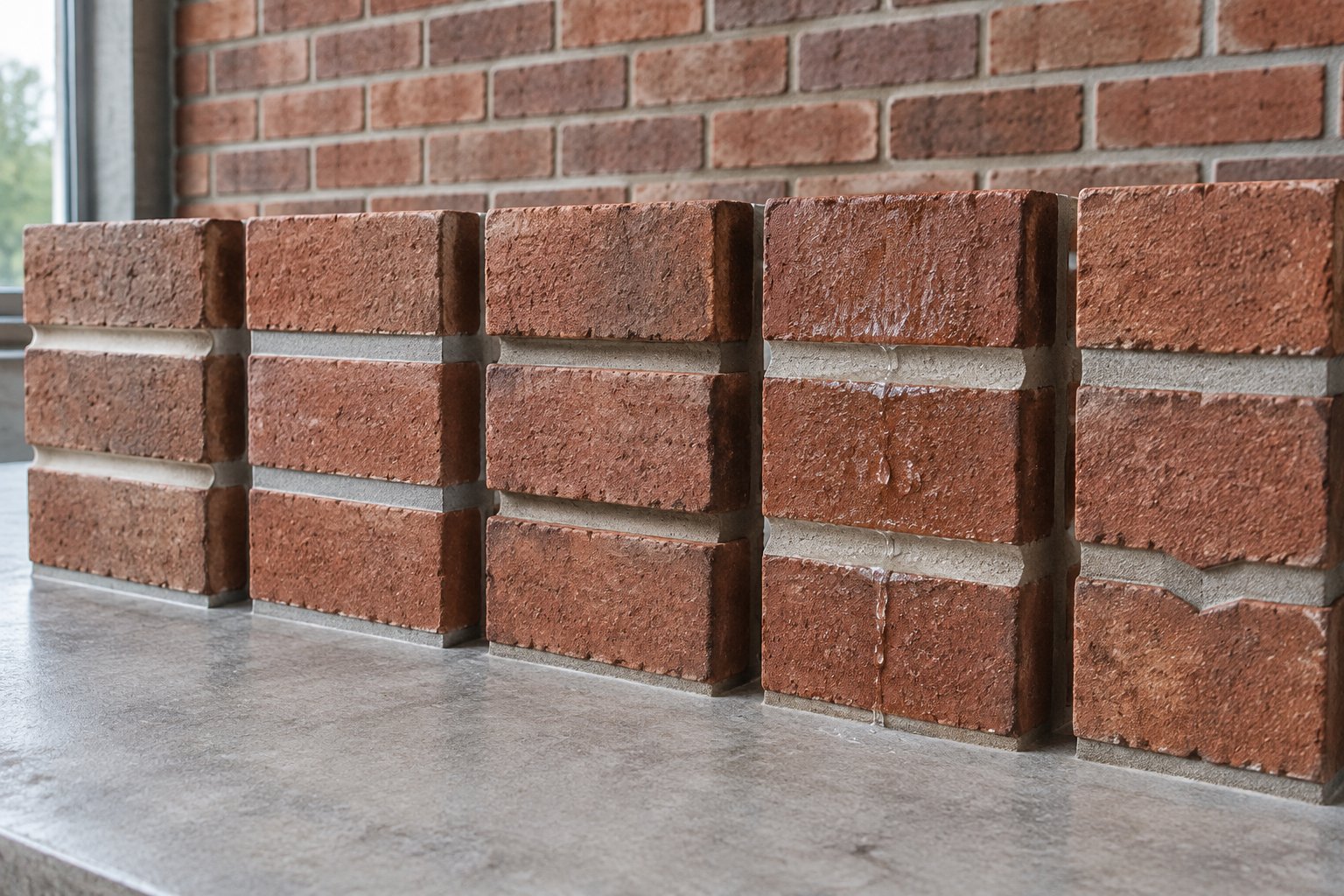
On a modern wall of hard-fired brick that strength is an asset. On soft historic brick it inverts the whole system: water that cannot get out through the joint goes out through the brick face instead, and when it freezes or leaves salts behind it lifts the fired skin off. We have covered what that does to soft red brick in detail elsewhere, but the short version is that it is not repairable. The brick gets replaced.
Movement is the other half of it. Cement-laid buildings need expansion joints because cement is brittle. In a lime wall every joint flexes a little, so the building moves as a whole rather than cracking through the units.
Self-healing, and what it will not do
Lime mortar can close its own hairline cracks. Water moving through dissolves a little free lime and redeposits it in the crack as it dries, and over enough wet and dry cycles fine cracks seal up.
It only works at small scale. It will not fix a wide crack, a failed joint, or anything caused by a foundation that is still moving, and the effect fades as the binder gets more hydraulic, because harder limes carry less free lime. Treat it as a bonus rather than a maintenance strategy.
Choosing the binder
The binder decides how the mortar hardens, how fast it gains strength, and how it copes with cold and damp.
Non-hydraulic lime, usually sold as lime putty, hardens by carbonation. As it dries, calcium hydroxide pulls carbon dioxide out of the air and turns slowly back into calcium carbonate. That takes months and carries on for years. It is the softest and most breathable option and it suits delicate low-fired brick and soft stone. Its weakness is water: if lime putty stays wet, air cannot reach it and it never properly sets, which makes it a poor choice for permanently damp locations and a risk in cold weather before it has carbonated.
Natural hydraulic lime, or NHL, contains clay minerals that let it set on contact with water, like cement but slower and softer. It takes an early set from that reaction then keeps hardening through carbonation. Masons coming from cement find it much easier to learn, setting times are predictable, and it resists frost sooner. The trade-off is that NHL keeps getting harder and less breathable as it ages, with some long-term UK studies suggesting it can approach Portland strengths after a couple of decades. That is a good argument for specifying the softest grade that will survive the exposure.
What the NHL number means
The figure after NHL is a strength class, and higher means harder and more hydraulic.
- NHL 2, the weakest and most breathable. Soft brick, soft stone, plaster, limewash.
- NHL 3.5, general-purpose repointing for harder brick and stone.
- NHL 5, very hard stone, modern brick or block, and permanently wet or sky-facing joints such as copings.
For most antique brick from roughly 1870 to 1940, NHL 2 or 3.5 is the conversation to have with your mason. NHL 5 on soft brick is the cement mistake again, just arriving more slowly.
Quicklime, hydrated lime and hot mixing are three different things
They start from the same stone and behave nothing alike. Quicklime is burnt limestone, and adding water to it produces a violent exothermic reaction. Hydrated lime is quicklime already slaked into a dry powder, and it is the bagged lime most American masons know from cement-lime blends. Hot mixed lime mortar is made by slaking quicklime directly with damp sand, which gives a sticky, lime-rich mortar closely matching a lot of historic work.
One real caution on hot mixing. Modern quicklime is far purer than what was burnt a century ago, and the old mixes picked up a slight hydraulic set from their impurities. Today's purer product carbonates very slowly and carries a genuine frost risk in colder climates. Quicklime is also a serious burn hazard and belongs only with crews trained to handle it.
Getting the mix right
Most lime mortars land around 1 part lime to 2.5 or 3 parts sand by volume. Treat that as a starting point rather than a recipe, because the right amount of binder depends on the void space between the sand grains, and that changes from quarry to quarry. Well-graded sand with fine, medium and coarse grains needs less lime than a uniform one. Too much and the mortar shrinks and cracks. Too little and it crumbles.
Measure by volume with a bucket or a gauge box. A shovel is not a unit of measurement, and the difference shows up in the wall.
Match the sand first and color mostly follows, because the color of a joint comes overwhelmingly from its aggregate rather than from pigment. Grain size has to suit the joint as well: the largest grains want to be around a third of the joint width, and since antique brick is smaller and more irregular than modern modular, its joints tend to be wider and less even. A fine modern sand in a wide old joint reads flat and wrong from the pavement. If the original mortar carries small white lumps of unburnt lime, or fragments of shell or charcoal, a proper match includes those too. Where pigment is genuinely needed, keep it to pure mineral oxides at no more than about 2% of the mix by weight.
On a significant building, on anything in a historic district, or on any large repointing job, pay for a lab analysis of the original mortar. It gives you binder type, sand gradation and rough proportions, which is what a mason needs to mix something that still matches in twenty years. On smaller jobs a field check gets you a long way: lime scratches easily, crumbles between the fingers and fizzes hard in acid, while cement barely reacts.
Build a test panel either way, at least three feet square, and let it cure properly before anyone judges the color, because lime shifts in tone considerably as it carbonates. The panel should also demonstrate how the crew intends to get the old mortar out without damaging the brick, which is often the more important thing to watch.
A note on pozzolans
A pozzolan gives non-hydraulic lime a hydraulic set. Metakaolin, brick dust and certain ashes and slags all work, and the Romans used volcanic ash for the same purpose. They buy you early strength and some frost resistance, which genuinely helps in a cold or damp climate.
They also add risk. Mixed on site, the final strength is hard to predict and can easily finish up harder than the brick. If your mason proposes one, ask which, how much, and why a weak NHL with known properties would not do the same job.
If a hard mortar has already cost you brick, send a photograph taken in daylight with a coin or a tape in the frame, or post us a loose brick. We will find the closest reclaimed match in stock, usually inside the week, and standard samples are free to the trade.
Curing, weather and what it costs
Lime firms up within a day or two, and that is only the beginning. Full carbonation takes weeks to months, and the outer skin of a joint cures long before its core. Hydraulic lime gains usable strength faster because of its initial set, while lime putty stays soft considerably longer. In both cases a joint that feels hard to the thumb is still vulnerable to frost, driving rain and fast drying.
Lime wants to stay damp but not saturated, with air moving across it. Dry it too fast and it powders. Keep it too wet and it cannot carbonate at all. UK lime guidance advises against lime work when temperatures are likely to drop below about 41F for several weeks afterwards, which in a northern climate can mean waiting for spring. In summer, work between roughly 50F and 77F, keep the wall out of direct sun, and mist new joints two or three times a day for at least a week to ten days, covering with burlap that does not touch the face. Never add antifreeze or a bag of cement to make a schedule work.
On a Gulf Coast summer job that mostly means shade, early starts and constant misting.
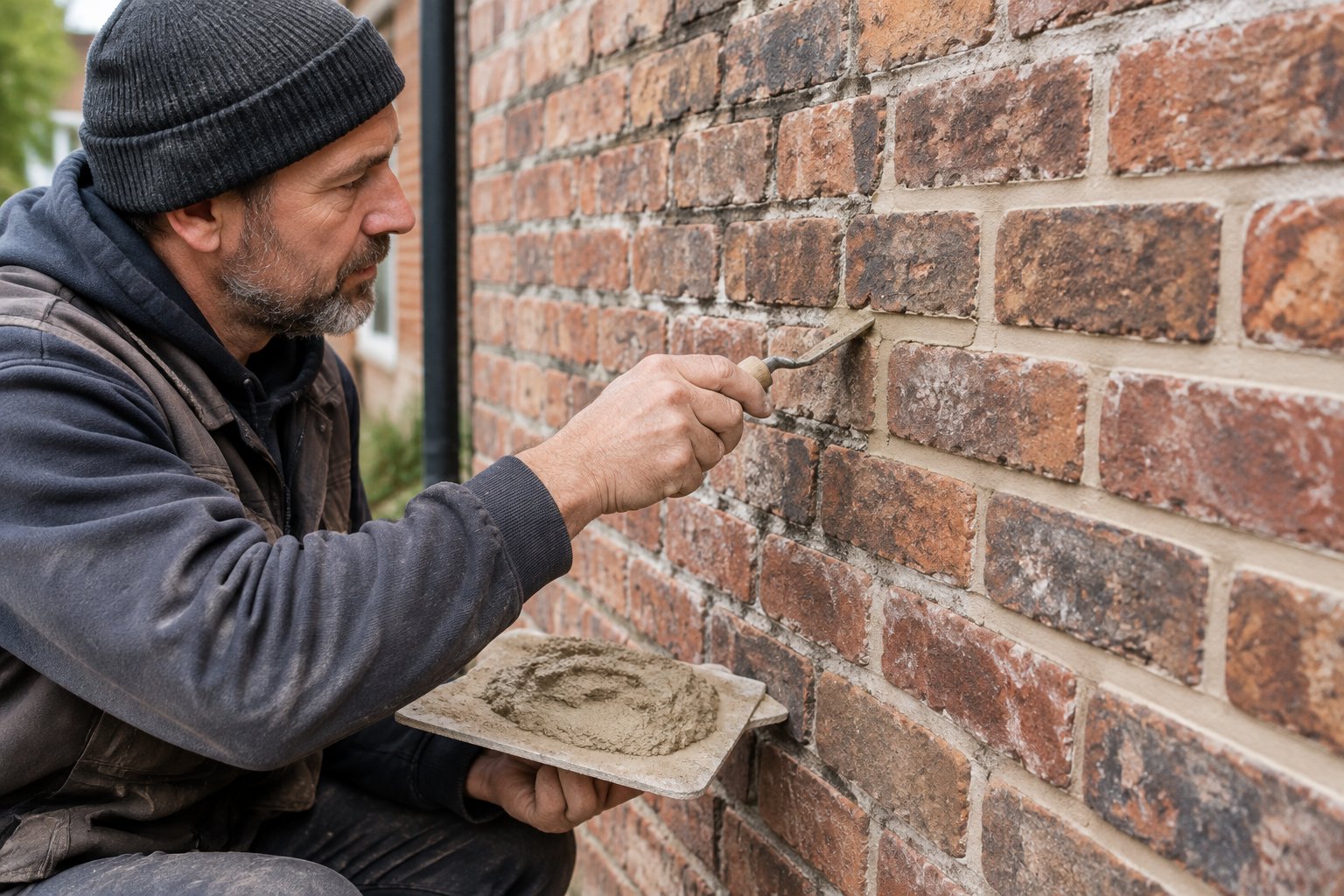
Lime costs more than cement, and almost all of the difference is time and skill rather than materials. Joints come out by hand to protect soft arrises, the mix gets tuned to the actual sand, and the work has to be tended for days after it goes in. Lime is also less forgiving of a mason used to cement, who will tend to overwork it, add too much water, or let it bake. Hire someone with documented lime experience and ask to see cured work. The premium is what you pay so that joints wear out instead of brick.
Why lime matters at the end of a wall's life
Lime is burnt at lower temperatures than Portland cement and reabsorbs carbon dioxide as it carbonates, which is the usual environmental argument. The more interesting one is what happens at demolition. Brick laid in lime comes apart whole, because the mortar cleans off without taking the arris with it.
That is the reason reclaimed brick exists in any quantity at all. Nearly every antique brick on a pallet anywhere in the country survived because it was bedded in something soft enough to let go. Build in lime today and the next generation can reuse the wall, which is the practical end of the case for sustainable reclaimed building materials.
What to specify before anything ships
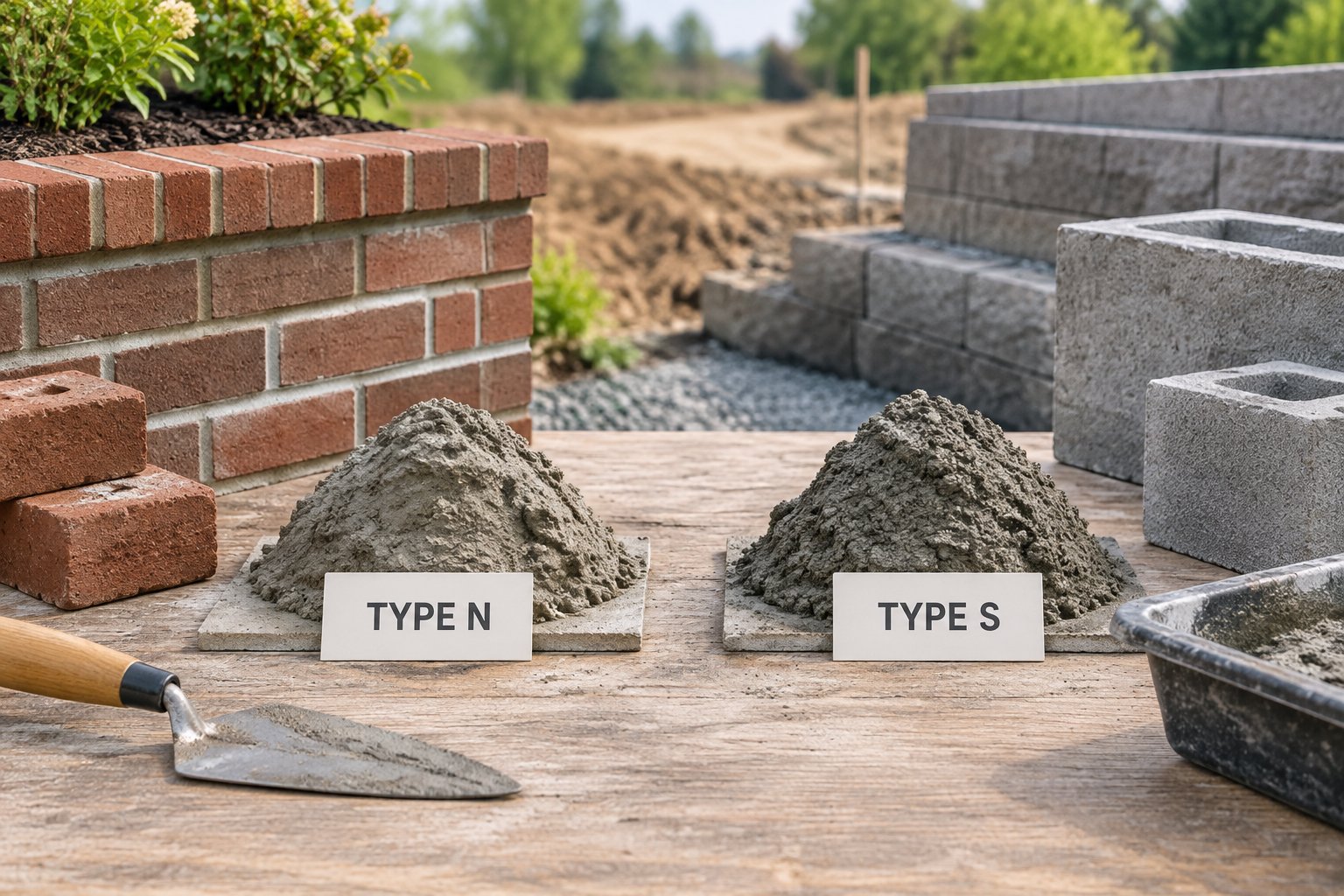
Write the brick and the mortar down together. For the binder, name it by type and grade rather than trusting a bag: a sack marked "lime" may well be hydrated lime blended for cement work, Type S hydrated lime is a different product from NHL 3.5, and neither one is lime putty. Write "NHL 2" or "non-hydraulic lime putty", plus the sand source and the ratio by volume. If the specification tolerates any cement at all, cap it. GSA guidance holds that up to 20% cement in the binder has minimal effect on hardness and that more than that makes the mortar too hard, though plenty of conservators prefer none whatsoever on very soft brick.
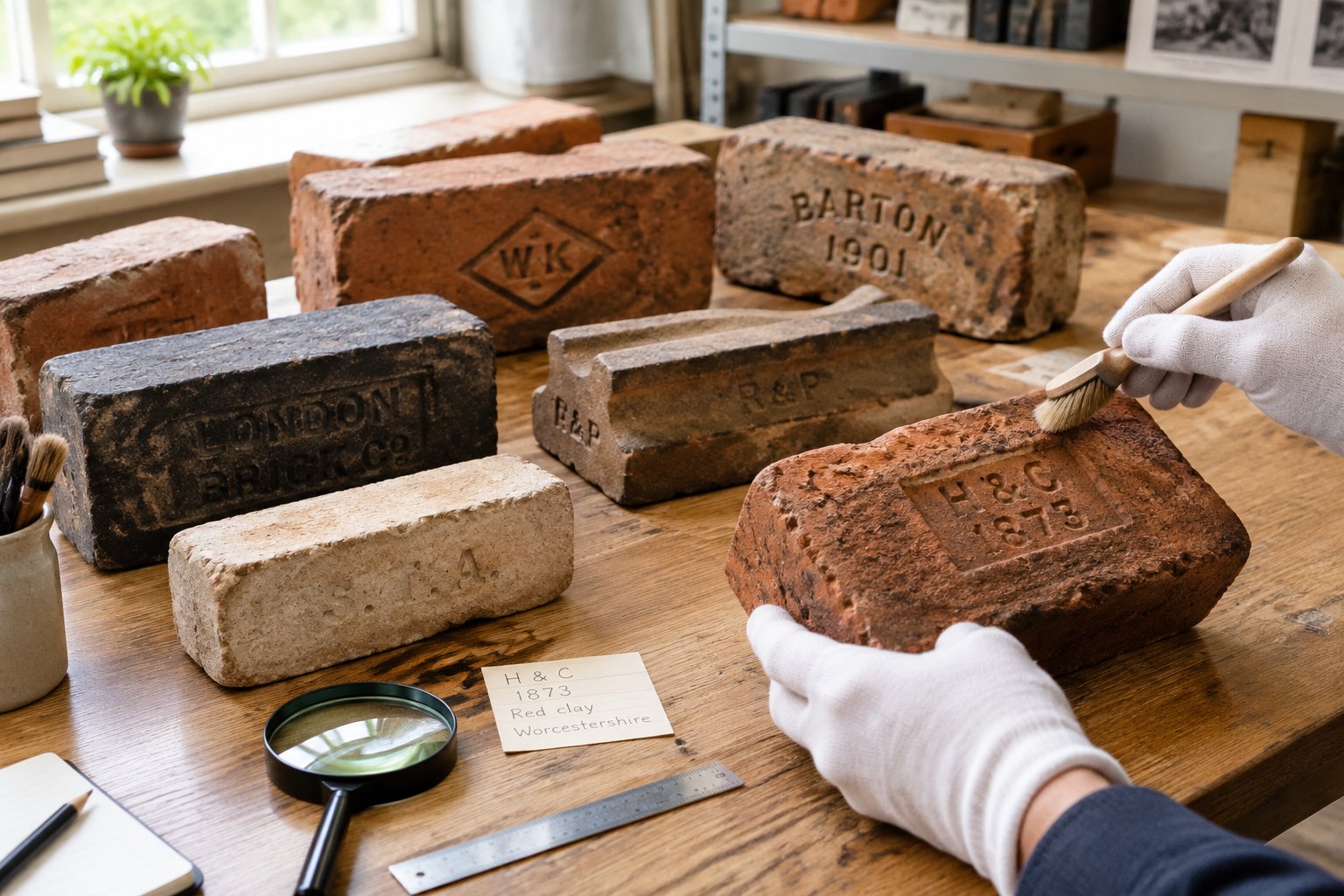
For the brick, match on size, color range, texture and the mortar around it. Antique brick predates modular sizing, so measure several units off the wall and record the range rather than one. Texture tells you how it was made: handmade brick has soft edges and uneven faces, early machine-made is crisper. Hardness feeds straight back into the mortar decision, since a soft red wants a gentler mix than a dense hard-fired unit. Our brick matching service works on all four together, and the house blends run from about $1.70 a brick for St Louis Red through $1.85 for Soft Red and Old Chicago to $2.00 for New Orleans Hard Tan.
Then hand the mason a written package: binder type and grade, sand source and gradation, mix ratio by volume, joint profile, the method for removing old mortar, curing and weather limits, and the size of test panel you expect to approve. Include the replacement brick count with spares, plus a few loose units for the panel itself. Our historic restoration page covers what we hold and how it gets documented for a review board, and what an old wall teaches a modern crew makes a decent briefing document to pass along with it.
We supply the brick and the written mortar guidance. We do not repoint, lay brick or install anything, so the work on the wall goes to a mason with lime on their record.
The joint wears so the brick does not
Lime works because it is softer and more breathable than the brick around it. Choose non-hydraulic putty for the softest units in sheltered positions, NHL 2 or 3.5 where you need an earlier set or more weather resistance. Match the sand to the original, tune the ratio to that sand rather than to a published figure, and prove it on a panel before the whole elevation goes up. Then protect the new work from sun and frost while it cures, and accept that it will take longer than you want.
When you need reclaimed brick to go in alongside it, we hold four blends on pallets ready to ship rather than on a six to twelve month lead time. Call the New Orleans office on 225-284-7529 or email hays@bourgeoismaterials.com and we will tell you straight what we can match and what we cannot.
Frequently asked questions
Why did lime mortar fall out of use?
Portland cement sets fast and hard, and that won. It arrived widely in the US around 1900, cement-lime blends were normal until roughly 1930, and cement has dominated new construction since. Speed and predictability beat compatibility, and the damage to soft historic brick only became obvious later.
Is lime better than cement for every brick wall?
No. Lime is right for soft pre-1900 brick and for new walls built from reclaimed brick of that era. Modern hard-fired brick was designed around cement mortar and performs perfectly well in it.
Is Type O the same as traditional lime mortar?
No. Type O is a cement-lime mortar, roughly 1 part Portland to 2 parts lime and 6 to 9 parts sand. Traditional lime mortar has no Portland in it at all, though Type O is sometimes a sensible starting point on later historic masonry that was itself laid in cement-lime.
Is bagged hydrated lime the same as NHL or lime putty?
No, and this trips people up constantly. Bagged hydrated lime is a plasticiser for cement mortars. It does not substitute for natural hydraulic lime or lime putty in a historic specification, so name the binder by grade when you order.
Can lime mortar be used as plaster or render?
Yes. Mixed for interior walls and ceilings it is lime plaster, applied externally it is lime render. Traditional lime plaster often went over wooden laths, and the binder rule is the same as for mortar: keep it softer and more breathable than whatever sits behind it.